Video tour of Mr. Stuckism. A Charles Thomson solo exhibtion at Black Ivory Printmaking & Audio Club.
Black Ivory Printmaking & Audio Club present
Mr. Stuckism
A Charles Thomson solo exhibition
Charles Thomson co-founded the Stuckism art group in 1999 with Billy Childish, who left in 2001.
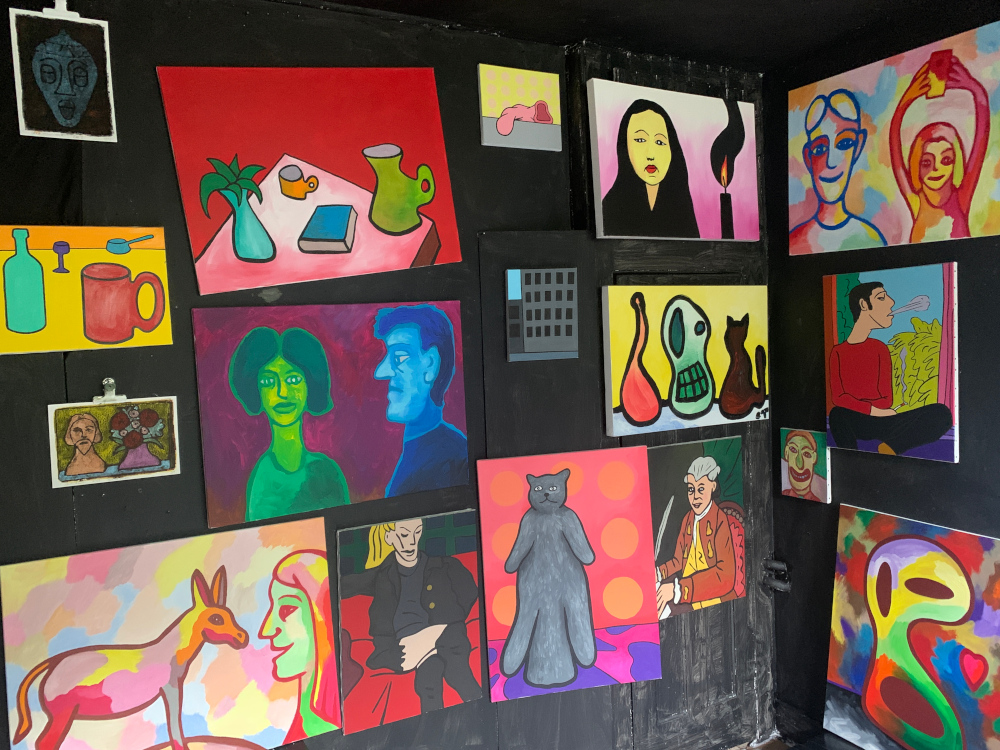
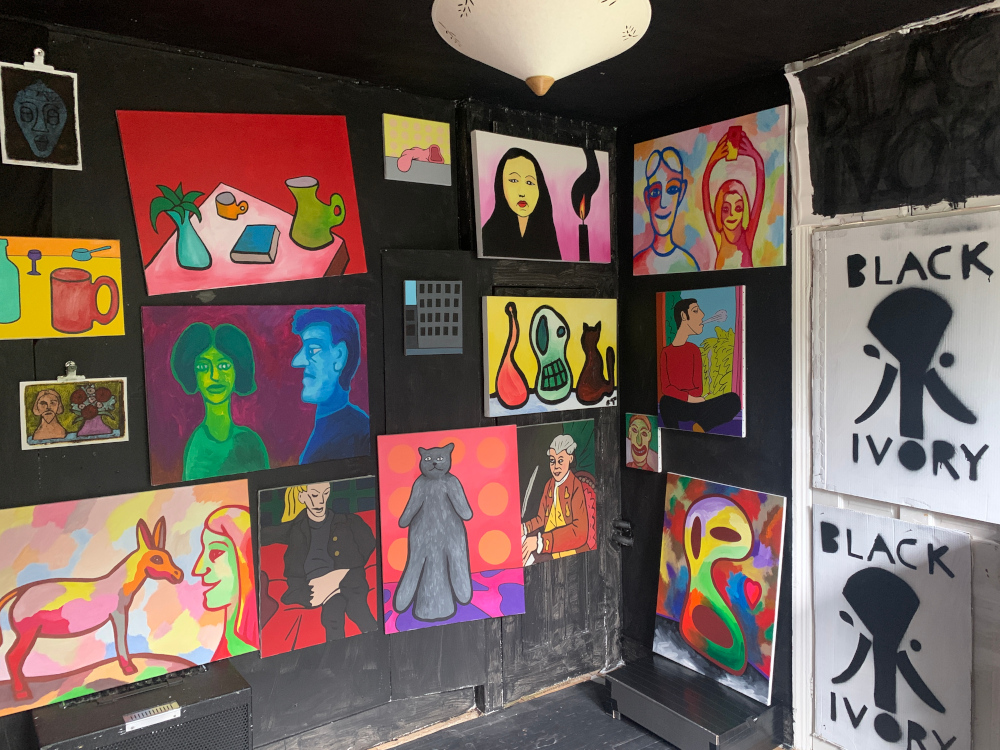
Exhibition curator, Edgeworth Johnstone: ‘Mr. Stuckism is the first in a series of Stuckist solo shows at Black Ivory Printmaking & Audio Club in Muswell Hill, London. This series follows immediately on from our Stuckist group show, titled Stuckism. Mr. Stuckism was conceived and hung on 20th and 21st July 2022. Mr. Stuckism includes two collaboration paintings by Thomson and Johnstone.
Black Ivory Printmaking & Audio Club is a private members club in Muswell Hill village, London, UK. It was founded around 2013 by Edgeworth Johnstone. It is now also a black wall gallery in direct response to the Stuckist manifesto.
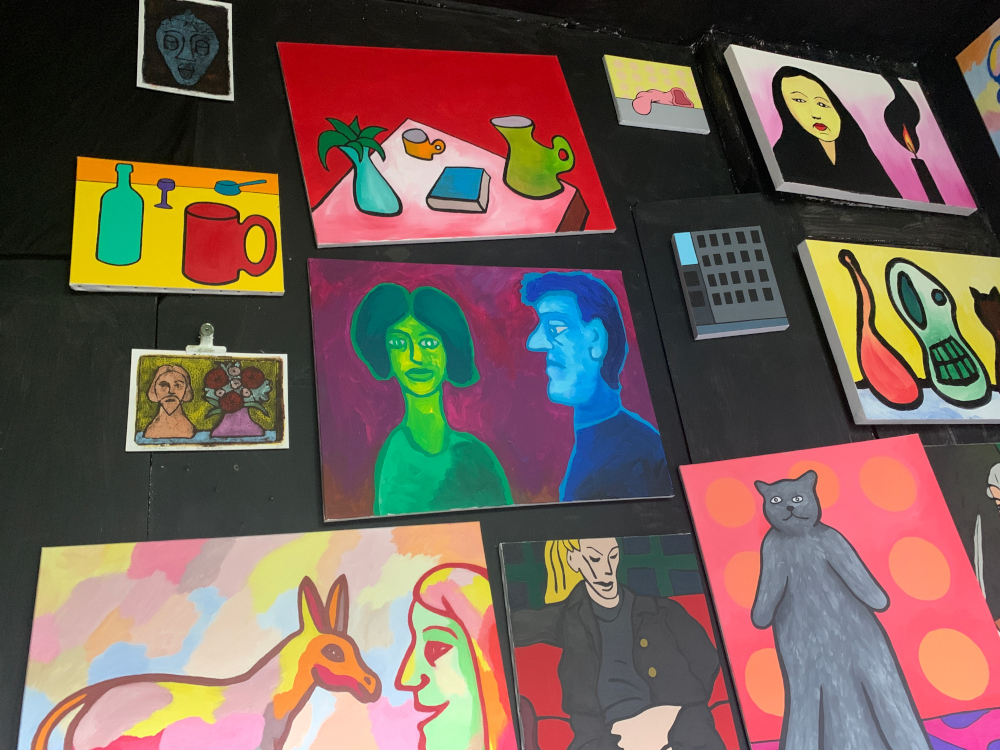
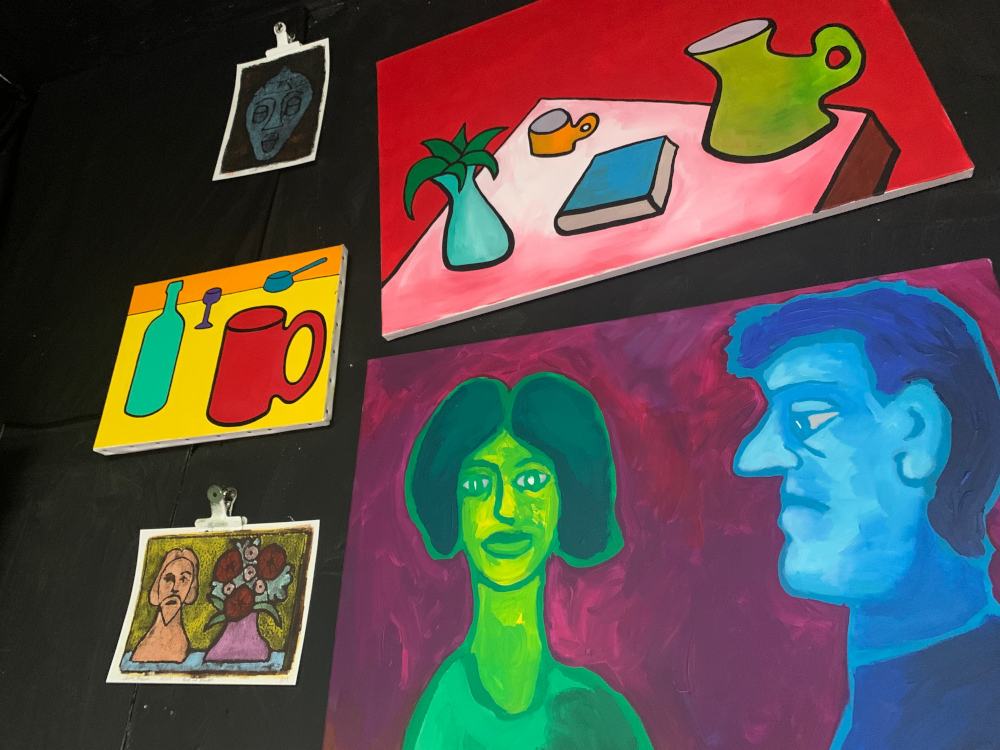
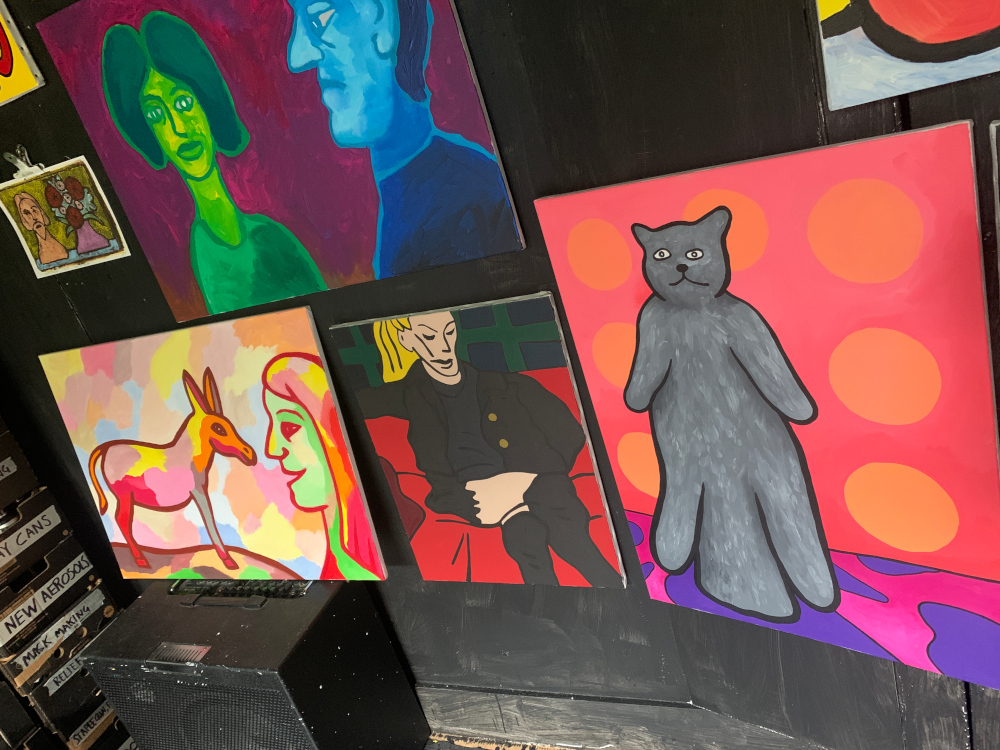
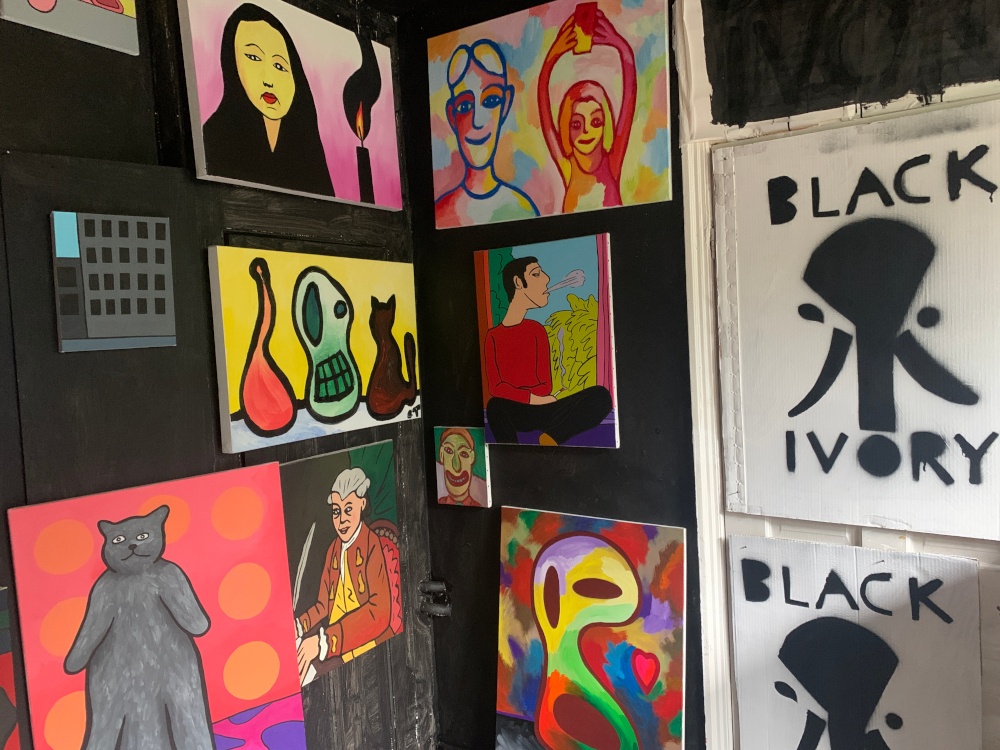
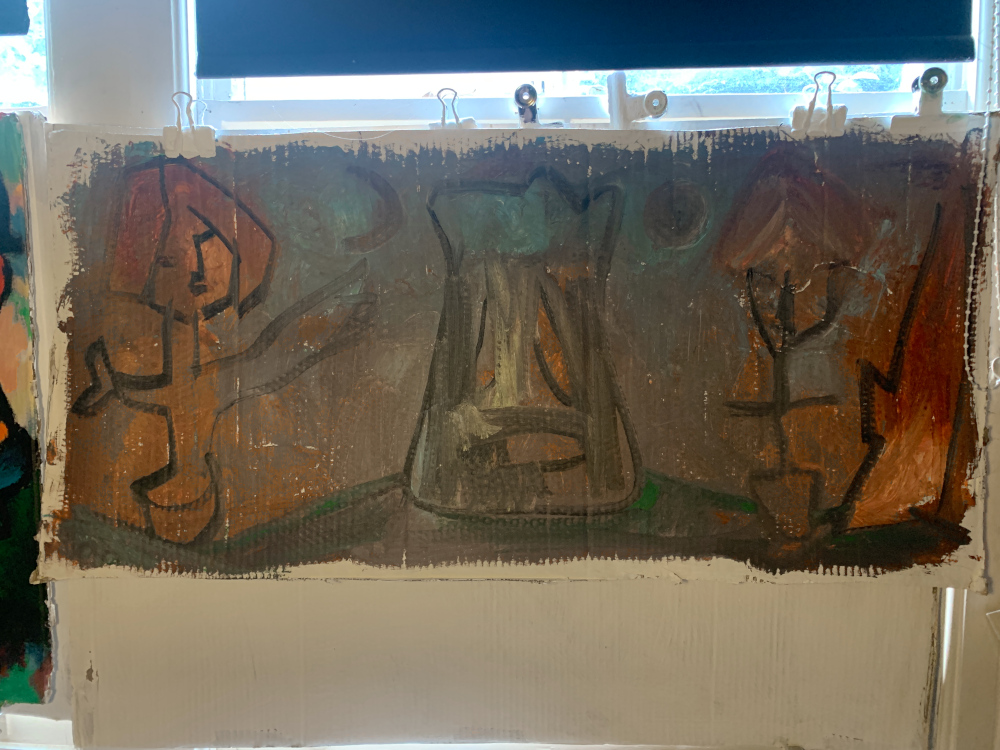
Mr. Stuckism a Charles Thomson solo exhibition at Black Ivory Printmaking & Audio Club. Photo: Edgeworth Johnstone 21st July 2022.Mr. Stuckism a Charles Thomson solo exhibition at Black Ivory Printmaking & Audio Club. Photo: Edgeworth Johnstone 21st July 2022. The art gallery was painted black in order to adhere as strongly as possible to the principles of the Stuckist manifesto.Mr. Stuckism a Charles Thomson solo exhibition at Black Ivory Printmaking & Audio Club. Photo: Edgeworth Johnstone 21st July 2022. View from below of the main painting area.Mr. Stuckism a Charles Thomson solo exhibition at Black Ivory Printmaking & Audio Club. Photo: Edgeworth Johnstone 21st July 2022. Notice the two small works on paper. Both made at Black Ivory Printmaking & Audio Club before the audio part.Mr. Stuckism a Charles Thomson solo exhibition at Black Ivory Printmaking & Audio Club. Photo: Edgeworth Johnstone 21st July 2022. Note the rare deep edge to the two paintings Thomson painted in Black Ivory Printmaking & Audio Club in early 2013.Mr. Stuckism a Charles Thomson solo exhibition at Black Ivory Printmaking & Audio Club. Photo: Edgeworth Johnstone 21st July 2022. Note the similarity between the double portrait and the composition of many of Thomson’s still life paintings.Mr. Stuckism a Charles Thomson solo exhibition at Black Ivory Printmaking & Audio Club. Photo: Edgeworth Johnstone 21st July 2022. Note the portrait painting of SP Howarth.Mr. Stuckism a Charles Thomson solo exhibition at Black Ivory Printmaking & Audio Club. Photo: Edgeworth Johnstone 21st July 2022. The small painting is after a Billy Childish painting.Mr. Stuckism a Charles Thomson solo exhibition at Black Ivory Printmaking & Audio Club. Photo: Edgeworth Johnstone 21st July 2022. Thomson psychedelia. Mr. Stuckism a Charles Thomson solo exhibition at Black Ivory Printmaking & Audio Club. Photo: Edgeworth Johnstone 21st July 2022. The small condom painting is one of many Thomson condom paintings of the same palette and size.Mr. Stuckism a Charles Thomson solo exhibition at Black Ivory Printmaking & Audio Club. Photo: Edgeworth Johnstone 21st July 2022. The mask is one of many hand-made one-off oil paint prints Thomson made of this image.Mr. Stuckism a Charles Thomson solo exhibition at Black Ivory Printmaking & Audio Club. Photo: Edgeworth Johnstone 21st July 2022. The hang is slightly wonky as it uses the same nails as the previous exhibition.Mr. Stuckism a Charles Thomson solo exhibition at Black Ivory Printmaking & Audio Club. Photo: Edgeworth Johnstone 21st July 2022. The Black Ivory door panels are a permanent feature of the Black Ivory Printmaking & Audio Club.Mr. Stuckism a Charles Thomson solo exhibition at Black Ivory Printmaking & Audio Club. Photo: Edgeworth Johnstone 21st July 2022. The gaffer taped Sainsburys cardboard box the skull painting is sitting on was custom made for this exhibition.Mr. Stuckism a Charles Thomson solo exhibition at Black Ivory Printmaking & Audio Club. Photo: Edgeworth Johnstone 21st July 2022. A collaboration painting by Charles Thomson and Edgeworth Johnstone.Mr. Stuckism a Charles Thomson solo exhibition at Black Ivory Printmaking & Audio Club. Photo: Edgeworth Johnstone 21st July 2022. A collaboration painting by Charles Thomson and Edgeworth Johnstone.
Edgeworth Band rehearsing at Mr. Stuckism
Join the Fan Club to receive our regular publications (Free worldwide shipping included).
Recorded in East Finchley, London, 24th May 2011. Jasmine Surreal and Charles Thomson performing. Edgeworth Johnstone on guitar. All three are in Stuckism groups. This was all the same day and part of the same event as Charles Thomson Poetry Readings.
Jasmine Surreal and Charles Thomson, Edgeworth Johnstone on guitar.
Jasmine Surreal and Charles Thomson performing, Edgeworth Johnstone off-camera on guitar. Neptunes Funny Trident.
Jasmine Surreal and Charles Thomson.
Join the Fan Club to receive our regular publications (Free worldwide shipping included).
Charles Thomson poetry readings. Recorded in East Finchley, London, 24th May 2011. Cameos from Jasmine Maddock and Edgeworth Johnstone. All three are members of Stuckism groups. These recordings were made the same day, and as part of the same event as Jasmine Maddock and Charles Thomson Performance Art.
Is it art? by Charles Thomson Left to right: Jasmine Maddock, Charles Thomson, Edgeworth Johnstone.
Charles Thomson performing his poem about Equivalent VIII by Carl Andre.
Charles Thomson, Stuckism co-founder reading his handy guide to the art world, and how to spot a fake Damien Hirst.
Charles Thomson performing The Dr. Who poem.
Charles Thomson performing his poem The Tube Train. Background voices Jasmine Maddock and Edgeworth Johnstone. End singing by Jasmine Maddock.
Join the Fan Club to receive our regular publications (Free worldwide shipping included).
First published in The Other Muswell Hill Stuckist newspaper, December 2012.
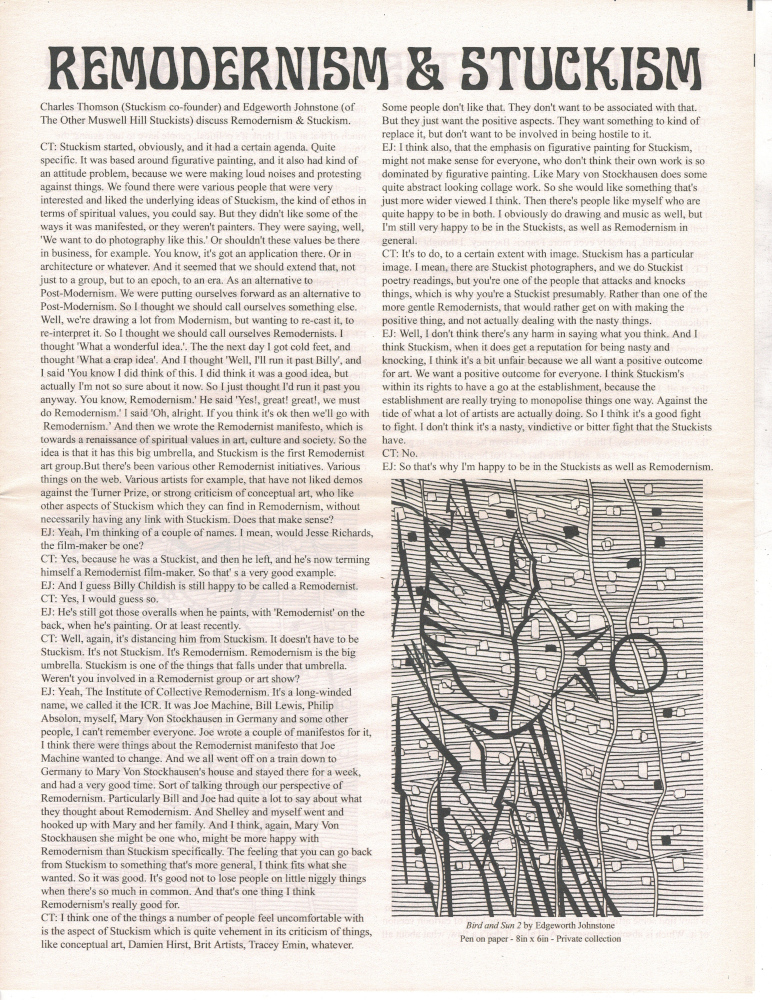
Charles Thomson (Stuckism co-founder) and Edgeworth Johnstone (of The Other Muswell Hill Stuckists) discuss Stuckist Collections & Tate.
EJ: At first I didn’t really understand why the Stuckists were opposing anything. I thought, why do they bother? They should just do their own work. And the more I got to know about it, and the more I got to see the missed potential within the art establishment to recognise such good artists. I mean, painters like Philip Absolon, Joe Machine…it would be so good for British culture, I think, if we had these artists around in galleries. Not always necessarily national galleries, but maybe at least some of the big name private galleries, in front of just people. I really got that side of Stuckism as well. The positive opposition to the art establishment. So you kind of get both sides, as time goes on.
CT: Yeah, that’s one of my bugbears is the Tate, which is a national gallery, and it’s funded by the public, and it’s run like it’s a private gallery. When Stephen Deuchar became the Director of Tate Britain, in 2000 I think it was, he said if you wanted a comprehensive overview of British art, or of art made in Britain, then this will be the place to come. That’s never been fulfilled. It’s not comprehensive at all. It’s highly selective. And when Julian Spalding ran a campaign for Beryl Cook to be in the Tate collection, it was ignored. Now, I’m not saying Beryl Cook’s my favourite artist, because she’s not. But obviously, a lot of people do like her. And those are the people that are paying for the gallery to exist, and they can’t go along and see her work there. Why not? Jack Vettriano is hugely popular as well. And again, he’s someone that has his supporters and isn’t included. Again, why not? In fact, why aren’t the Stuckists there? There’s lots of people that aren’t in there. John Keane is a figurative painter for example. The representative, leading artists of the Federation of British Artists aren’t in there. People like Ken Howard, who has sell-out shows, is a very accomplished painter. Fred Cumin, Bill Bowyer, people like that. And who’s the one that does the big female nudes, that Saatchi patronised? I can’t remember her name.
EJ: The one in Sensation?
CT: Yes.
EJ: Can’t remember her name.
CT: She’s not in there either, which is kind of bizarre. And then when you see what is in there, what does get bought, you realise it’s actually far from comprehensive. It’s a narrow, very narrow, very selective take on contemporary art. Very narrow minded, and very prejudiced. Very partial to certain aspects of the fashionable which are basically promoted by commerce. By the certain leading galleries. By auction houses, and funded by people with more money than sense. And the Tate is now doing exactly what it did in previous decades. Namely, the Directors choice of a small area of art. Not representing the whole picture. And later people turn round and say ‘Wow, this guy, this past Director really got it wrong when he turned down, when he could have included it.’ And I think exactly the same thing is happening now. This current Director is making exactly the same mistake as in the past. And people turn round in the future and say ‘Wow, what a mistake.’ The same thing.
EJ: Yeah, and I think in a way it’s even worse. Because it’s actually a British art movement. It’s obviously, like previous Directors, in your article, you pointed out ‘The Red Studio’ by Matisse. It could be hung in Tate Modern today, if it wasn’t for the Director having his own personal angle and not buying it. Regardless of what was best for the country. Obviously Matisse wasn’t English, he wasn’t British. And to have, really, the only art movement around that’s doing anything like Stuckism. Being, for once, a British art movement, probably the major one in the world, I think. In terms of really getting on with Modernism and following it up. And it’s just a real refusal to have it in. I mean to turn that Walker Gallery donation down, is just insanity really, when you think of what that represented. I mean, a once only chance to get a good early collection of Stuckist work. To get that kind of work together again, would be extremely difficult. And it’s gone now, the public don’t have it, because this guy decided it wasn’t his thing.
CT: Well, Jenny Saville was the name I was looking for earlier on, who’s not represented. I keep on finding more and more people that aren’t represented. But going back to past Tate Directors. James Bolivar Manson said that Henry Moore would be in the Tate over his dead body. And Sir Nicholas Serota hasn’t said exactly the same about the Stuckists, but simply said they are not sufficiently accomplished to warrant preservation in perpetuity in a national collection. Sounds really just the same thing. History repeating itself. But let’s move on from the Tate, because the Tate follows, it has done in the past. Usually too late, so it will have to follow again when it’s too late. We’re not too late, I’m mean we’re here now. Fortunately I’m in a position of being able to have that experience. That cultural experience. That art which is meaningful, which the Stuckists are doing. And it’s on the basis of my experience that, and how much I’ve gained from that, that motivates me to try and disseminate it. Because I know what it’s brought to my life, and how it’s enriched my life. And I think it would be good if that could happen with more people.
EJ: That’s it. I mean, I keep on seeing people keep churning out such good work in Stuckism. It’s just impulse to want it out there for people to see.
CT: It’s like if you were around in the nineteenth century when people were doing their work and being ignored. Or when Van Gogh was doing his work and being ignored. Or any of the people who initially were creating something which the establishment turned down and rejected. You can it’s the same thing happening again.
EJ: It’s frightening to think that had things not changed with Impressionism, a lot of Cezannes could have ended up in a skip. If there are people in high places that have their own agenda, which obviously Sir Nicholas Serota’s announced. He’s got an anti-painting, anti-sculpture agenda, you will have masterpieces in skips if these people are allowed to run riot with the national collection, and the art scene.
CT: But fortunately, just as there were with Impressionists, and later with people like Matisse and Picasso in their early days, there are a small number of enlightened and perceptive private collectors, who are doing very well for themselves. By getting work at a price before the market demand. which is very encouraging. What’s amazing is that it has all the hallmarks, all the characteristics of these earlier movements.
EJ: It’s nice to hear people believe in the work as well, you know. There’s people out there that have said such nice things to a number of Stuckist artists. I’ve had a few things myself, and I hear from other artists as well about collectors of their work. It’s like the Gertrude Stein.
CT: I mean David Roberts, who’s a massive collector and has work by a number of Stuckist artists. Of course, recently there’s been quite a lot of encouragement from Edward Lucie-Smith, who’s particularly singled out Jasmine Maddock and Joe Machine. And there’s other people, I’m not going to mention their names, because they’re private individuals. Also abroad as you know. Someone building up a very nice collection who’s in Hong Kong. So what we’re doing is, more shows. The books and shows are there. I don’t think anybody has had the opportunities in the past that we have, in promoting world-wide through technology.
EJ: Stuckism’s really the number one success story of internet art movements. The first and most successful. Was it Ella that started it?
CT: Yeah. This was when we started the group in 1999. And fortunately Ella Guru was working in web design. I didn’t know anything about it. I knew that we should do it. It was beyond my knowledge and ability at the time, and we worked together on that. And that was before anybody had heard of Stuckism. Before the first show. Before the first press mention. We’re talking about the first half of 1999. I remember being with her in a room in her flat with Sexton, their flat in Archway, and creating this. And there was a tremendous sense of excitement I felt, that this was going to go out to the world. And nobody knew where it was being developed, being hatched there. And I think in the first few months we had about thirty hits. Most of them probably Ella checking up on the website, and a couple from her friend Francis Castle who had a look at it. And that was it. I don’t know how many they’ve been now, but you know, we get tens of thousands every year.
Join the Fan Club to receive our regular publications (Free worldwide shipping included).
The New Statesman: “…a pinch of history and a sense of humour – The Founding, Manifesto and Rules of the Other Muswell Hill Stuckists was issued on 20 February 2009. Blast novelty. Bless authenticity. Long live the cup of tea!” – 27 January 2011.
Carluke Gazette:”…the wearisome Stuckists… I could understand having one of their pronouncements (the Founding, Manifesto And Rules Of The Other Muswell Hill Stuckists is the wittiest, denouncing “YBA” as “You’ll Believe Anything” and features the most succinct definition of their position; “to be unconventional is to conform”…but all three?” – 12 January 2011. –
Peter Murray, in The Irish Examiner: “…peevish utterances of suburban intellectuals. A recent example, issued in 2009 by “the Other Muswell Hill Stuckists”, illustrates the redundancy of the form. Published on the centenary of Marinetti’s manisfesto, the activists of Muswell Hill manage little more than a tired denounciation of the Groucho Club, the Turner Prize and Tracey Emin. At least their manifesto is short. Less witty, and much too long, is the 2008 Manifesto Towards a New Humanism in Architecture…” – 26 February 2011. (The Other Muswell Hill Stuckists maintain that they never denounced The Groucho Club.)
Alex Danchev in The Independent: “One hundred years to the day after the founding manifesto of Futurism was splashed across the front page of Le Figaro, The Founding Manifesto and Rules of The Other Muswell Hill Stuckists was published online. As their moniker might suggest,
The Other Muswell Hill Stuckists have a sense of humour. They believe in painting, as opposed to conceptual art. “Running is not art. Scrunching up a sheet of paper into a ball is not art. Sticking blu-tack on the wall is not art. People who think it is need to get out more.” If Damien Hirst’s dead sheep is truly the Stuckist bête noire, Tracey Emin’s unmade bed runs it a close second. The Stuckists mobilised against the Young British Artists (“YBA means you’ll believe anything”), the Turner Prize, and the Tate. As a body, or a cause, they may be irremediably marginal, not to say parochial, yet from time to time they have been surprisingly effective. Their very existence is a tonic. Wyndham Lewis was once said to be a kind of British (or English) rearguard action against the Futurist incursion – the arrière-garde against the avant-garde. The Stuckists seem to show that there is space for an English arrière-garde after all.” 11 February 2011.
The Observer – The New Review: William Skidelsky selects four, including The Founding, Manifesto and Rules of The Other Muswell Hill Stuckists. – 23 May 2011.
A MANIFESTO TO END 100 YEARS OF MANIFESTOS
On the 20th February 2009, 100 years to the day after the first, and main manifesto of The Futurists, The Other Muswell Hill Stuckists released “The Founding, Manifesto and Rules of The Other Muswell Hill Stuckists” in opposition. Professor Alex Danchev collated 100 art manifestos covering this 100 year period, opening with the Futurists and closing with The Other Muswell Hill Stuckists. These manifestos, together with his own writings comprised his book, 100 Artists Manifestos: From the Futurists to the Stuckists (published in 2011 by Penguin – Modern Classics), which also included the Stuckists first, and Remodernism manifesto. As of this writing in December 2012, Danchev’s book is in its forth printing.
Speaking of The Other Muswell Hill Stuckists on ABC Radio National, in Australia On 25 May 2011, Danchev said “The Stuckists are also in the vein of wit, in the vein of being against something.”
Join the Fan Club to receive our regular publications (Free worldwide shipping included).
Published in The Other Muswell Hill Stuckist newspaper, December 2012. See Media Reaction.
In order to redress upon its centenary the artistic and philosophical deficiencies of the first manifesto of the useless Futurists, The Other Muswell Hill Stuckists declare as follows:
The Other Muswell Hill Stuckists defy and accept the centuries in order to exist in the present, which is an appreciation of the past and a design for the future.
The Buddha does not distinguish between Muswell Hill, New York, Moscow, Venice or Crouch End.
Neither do the Other Muswell Hill Stuckists.
Our only good art teachers were in primary school, where we were encouraged to express ourselves with paint. We reject everything we have been told about art since then, in order to complete the circle of learning.
To be a Stuckist is to be free of being stuck and to recognise that all art is conceptual, except conceptual art.
The Other Muswell Hill Stuckist does not necessarily live in Muswell Hill, and knows that a horse has four legs.
To be challenging in art today presents no challenge at all. To be revolutionary in art today is to be a reactionary. To be unconventional is to conform. All the barriers that need to be broken have been broken already. The need today is to find out and affirm what is valuable, in the face of contempt.
People cannot escape from their essential needs and emotions, although they might pretend they do. This leads to a craving to be a celebrity.
Stuckism is a 21st century art movement. Without it, artists are bleached whale bones on the beach of a tourist resort.
The Other Muswell Hill Stuckists are in general agreement with the Stuckist Manifesto and are not ashamed of this.
The Other Muswell Hill Stuckists are not elitists or political. We denounce dismal and depressing urban landscapes, sexism, fascism, Futurism, nationalism, militarism, patriotism, non-renewable energy sources, white wall galleries, starvation, violent assaults, built-in obsolescence, the glorification of war, the decline of libraries and museums, the nocturnal vibration of the arsenals, and factories suspended from clouds.
Painting is the medium of yesterday; and of today; and of tomorrow.
Painting pictures is a human communication in a pre-packaged world of uniformly sized, tasteless tomatoes and so-called art which is afraid to be vulnerable, make mistakes and do anything apart from replicating in a gallery something that is commonplace everywhere else.
Running is not art. Scrunching up a sheet of paper into a ball is not art. Sticking blu-tack on the wall is not art. People who think it is need to get out more.
The Other Muswell Hill Stuckists demonstrate against the Turner Prize in order to restore dignity to the national museum of British art.
The Other Muswell Hill Stuckist is usually not a member of the Groucho Club, and is not expected to know what it is.
We are hoping to put an end to banal art.
We hit out at the likes of modern artist Tracey Emin.
YBA means you’ll believe anything.
We aim to replace Postmodernism with Remodernism, using paint to express experience, intellect and emotion. Stuckism is the future of art. It stands for integrity and creativity, and is against the tins of shit in art galleries all over the world.
Edgeworth Johnstone, Shelley Li and The Other Muswell Hill Stuckists with the Stuckist Bureau of Information. Official date of issue: 20 February 2009.
The Founding, Manifesto and Rules of The Other Muswell Hill Stuckists https://t.co/seAGXiaiR5
First published in The Other Muswell Hill Stuckist newspaper, December 2012.
TRACEY EMIN’S ATTITUDE PROBLEM LIVES ON
Someone slated Stuckism under one of our Youtube videos, saying we’re ‘stuck’, and ‘not realizing it’s 2012, not 1912.’ Like Tracey Emin’s insult that named Stuckism. Like painting can’t relate to modern life. It’s old fashioned because it’s painting. Stuckists are stuck for not being contemporary for its own sake, or stuck with the thinking you have to choose new ways of making art to say anything new. Like Sir Nicholas Serotas ‘radical unseating of painting and sculpture’, Paul Myners CBE, saying ‘Painting is the medium of yesterday’. People being pretty much the same as thousands of years ago, and art being about human experience doesn’t seem to count for anything. If it’s like fashion, progressing just because time is, always away from what it’s changed from, it’s less about being human as being told what you’re no longer supposed to do. Camberwell Art college telling one of its students, Stuckist S P Howarth, he hadn’t done any work, as his paintings didn’t count as work. They weren’t acceptable in ‘contemporary practice’. Stuckism may be anti conceptual art, but it’s at least based on the work. Stuckism thinks conceptual art is missing artistic values, often to the point of not being art. It wouldn’t rubbish an artist for not being in vogue.
Join the Fan Club to receive our regular publications (Free worldwide shipping included).
First published in The Other Muswell Hill Stuckist newspaper, December 2012.
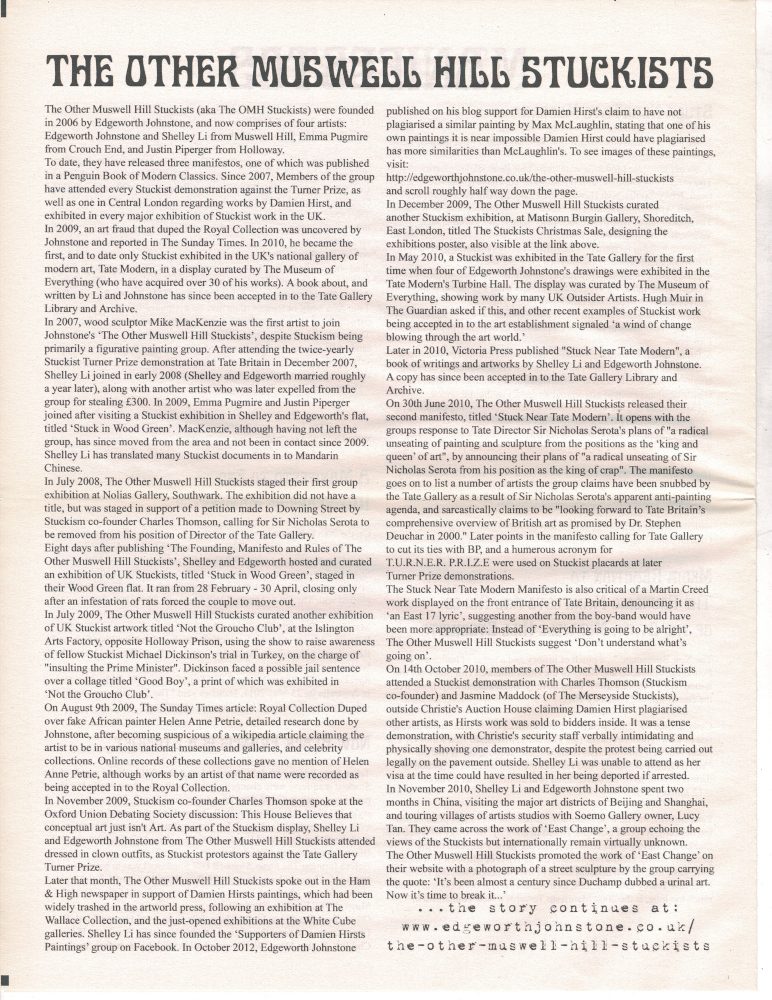
The Other Muswell Hill Stuckists (aka The OMH Stuckists) were founded in 2006 by Edgeworth Johnstone, and now comprises of four artists: Edgeworth Johnstone and Shelley Li from Muswell Hill, Emma Pugmire from Crouch End, and Justin Piperger from Holloway.
Shelley Li has translated many Stuckist documents into Mandarin Chinese.
In July 2008, The Other Muswell Hill Stuckists staged their first group exhibition at Nolias Gallery, Southwark. The exhibition did not have a title, but was staged in support of a petition made to Downing Street by Stuckism co-founder Charles Thomson, calling for Sir Nicholas Serota to be removed from his position of Director of the Tate Gallery.
Eight days after publishing ‘The Founding, Manifesto and Rules of The Other Muswell Hill Stuckists’, Shelley and Edgeworth hosted and curated an exhibition of UK Stuckists, titled ‘Stuck in Wood Green’, staged in their Wood Green flat. It ran from 28 February – 30 April, closing only after an infestation of rats forced the couple to move out.
In July 2009, The Other Muswell Hill Stuckists curated another exhibition of UK Stuckist artwork titled ‘Not the Groucho Club’, at the Islington Arts Factory opposite Holloway Prison, using the show to raise awareness of fellow Stuckist Michael Dickinson’s trial in Turkey, on the charge of “insulting the Prime Minister”. Dickinson faced a possible jail sentence over a collage titled ‘Good Boy’, a print of which was exhibited in ‘Not the Groucho Club’.
On August 9th 2009, The Sunday Times article: Royal Collection Duped over fake African painter Helen Anne Petrie, detailed research done by Johnstone, after becoming suspicious of a wikipedia article claiming the artist to be in various national museums and galleries, and celebrity collections. Online records of these collections gave no mention of Helen Anne Petrie, although works by an artist of that name were recorded as being accepted into the Royal Collection.
In November 2009, Stuckism co-founder Charles Thomson spoke at the Oxford Union Debating Society discussion: This House Believes that conceptual art just isn’t Art. As part of the Stuckism display, Shelley Li and Edgeworth Johnstone from The Other Muswell Hill Stuckists attended dressed in clown outfits, as Stuckist protestors against the Tate Gallery Turner Prize.
Later that month, The Other Muswell Hill Stuckists spoke out in the Ham & High newspaper in support of Damien Hirsts paintings, which had been widely trashed in the artworld press, following an exhibition at The Wallace Collection, and the just-opened exhibitions at the White Cube galleries. Shelley Li has since founded the ‘Supporters of Damien Hirsts Paintings’ group on Facebook.
In October 2012, Edgeworth Johnstone published on his blog support for Damien Hirst’s claim to have not plagiarised a similar painting by Max McLaughlin, stating that one of his own paintings it is near impossible Damien Hirst could have plagiarised has more similarities than McLaughlin’s.
In December 2009, The Other Muswell Hill Stuckists curated another Stuckism exhibition, at Matisonn Burgin Gallery, Shoreditch, East London, titled The Stuckists Christmas Sale, designing the exhibition’s poster.
In May 2010, a Stuckist was exhibited in the Tate Gallery for the first time when four of Edgeworth Johnstone’s drawings were exhibited in the Tate Modern’s Turbine Hall. The display was curated by The Museum of Everything, showing work by many UK Outsider Artists. Hugh Muir in The Guardian asked if this, and other recent examples of Stuckist work being accepted in to the art establishment signaled ‘a wind of change blowing through the art world.’
Later in 2010, Victoria Press published “Stuck Near Tate Modern”, a book of writings and artworks by Shelley Li and Edgeworth Johnstone. A copy has since been accepted into the Tate Gallery Library and Archive.
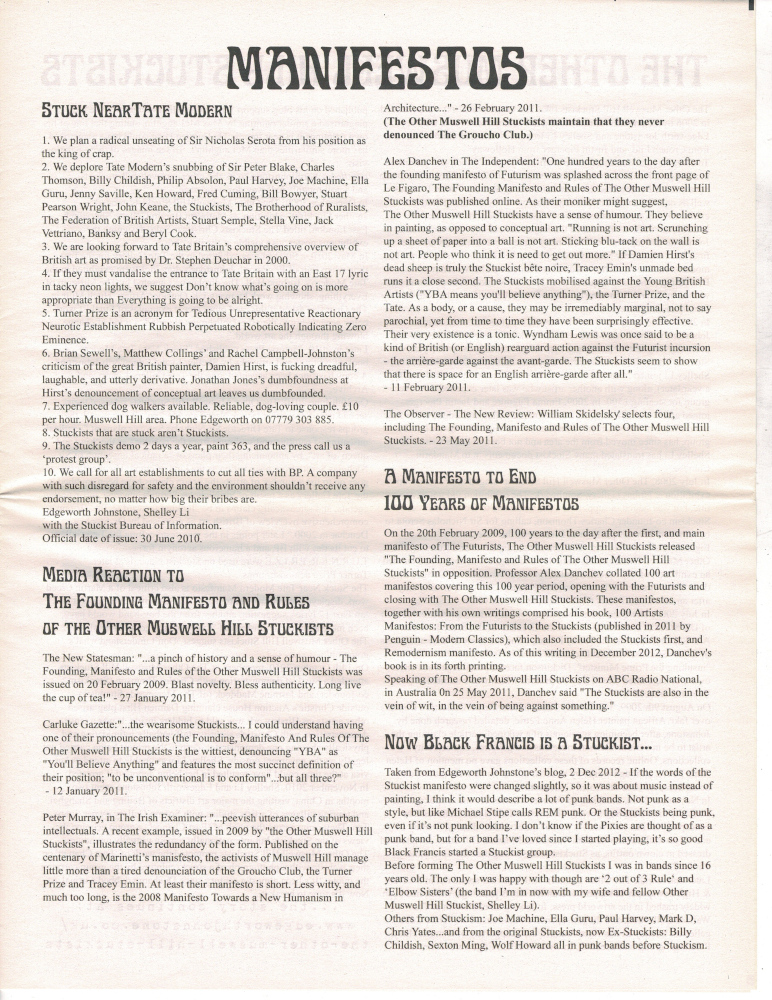
On 30th June 2010, The Other Muswell Hill Stuckists released their second manifesto, titled ‘Stuck Near Tate Modern’. It opens with the groups response to Tate Director Sir Nicholas Serota’s plans of “a radical unseating of painting and sculpture from the positions as the ‘king and queen’ of art”, by announcing their plans of “a radical unseating of Sir Nicholas Serota from his position as the king of crap”. The manifesto goes on to list a number of artists the group claims have been snubbed by the Tate Gallery as a result of Sir Nicholas Serota’s apparent anti-painting agenda, and sarcastically claims to be “looking forward to Tate Britain’s comprehensive overview of British art as promised by Dr. Stephen Deuchar in 2000.” Later points in the manifesto calling for Tate Gallery to cut its ties with BP, and a humerous acronym for T.U.R.N.E.R. P.R.I.Z.E were used on Stuckist placards at later Turner Prize demonstrations.
The Stuck Near Tate Modern Manifesto is also critical of a Martin Creed work displayed on the front entrance of Tate Britain, denouncing it as ‘an East 17 lyric’, suggesting another from the boy-band would have been more appropriate: Instead of ‘Everything is going to be alright’, The Other Muswell Hill Stuckists suggest ‘Don’t understand what’s going on’.
On 14th October 2010, members of The Other Muswell Hill Stuckists attended a Stuckist demonstration with Charles Thomson (Stuckism co-founder) and Jasmine Maddock (of The Merseyside Stuckists), outside Christie’s Auction House claiming Damien Hirst plagiarised other artists, as Hirsts work was sold to bidders inside. It was a tense demonstration, with Christie’s security staff verbally intimidating and physically shoving one demonstrator, despite the protest being carried out legally on the pavement outside.
In November 2010, Shelley Li and Edgeworth Johnstone spent two months in China, visiting the major art districts of Beijing and Shanghai, and touring villages of artists studios with Soemo Gallery owner, Lucy Tan. They came across the work of ‘East Change’, a group echoing the views of the Stuckists but internationally remain virtually unknown. The Other Muswell Hill Stuckists promoted the work of ‘East Change’ on their website with a photograph of a street sculpture by the group carrying the quote: ‘It’s been almost a century since Duchamp dubbed a urinal art. Now it’s time to break it…”
Join the Fan Club to receive our regular publications (Free worldwide shipping included).















 Stuckism .co.uk