Tag Archives: stuckism

Heckel’s Horse Jr. interview at Heckel’s Horse Jr.

Site managed by Black Ivory
Site Map | Instagram | Fan Club

Heckel’s Horse Jr. interviewed at Black Ivory Printmaking & Audio Club, Muswell Hill, London. August 9th 2022 by Charles Thomson, Stuckism co-founder.

Click HERE for the official Heckel’s Horse Jr. webpage.

Heckel’s Horse Jr. (aka Edgeworth Johnstone) interviewed by Charles Thomson.

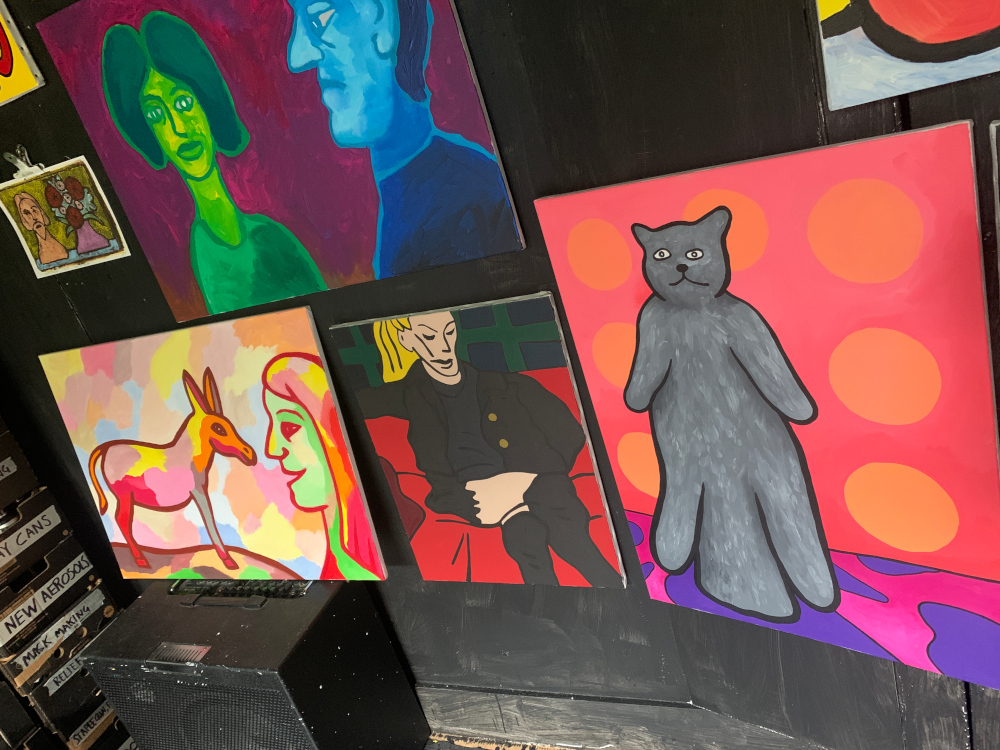
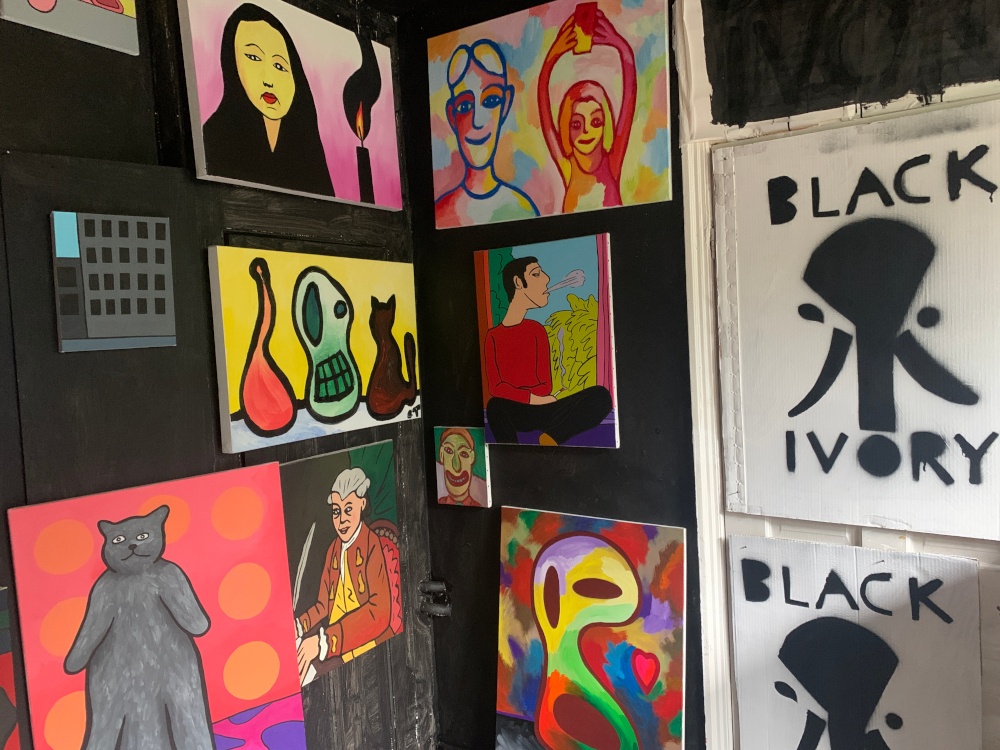
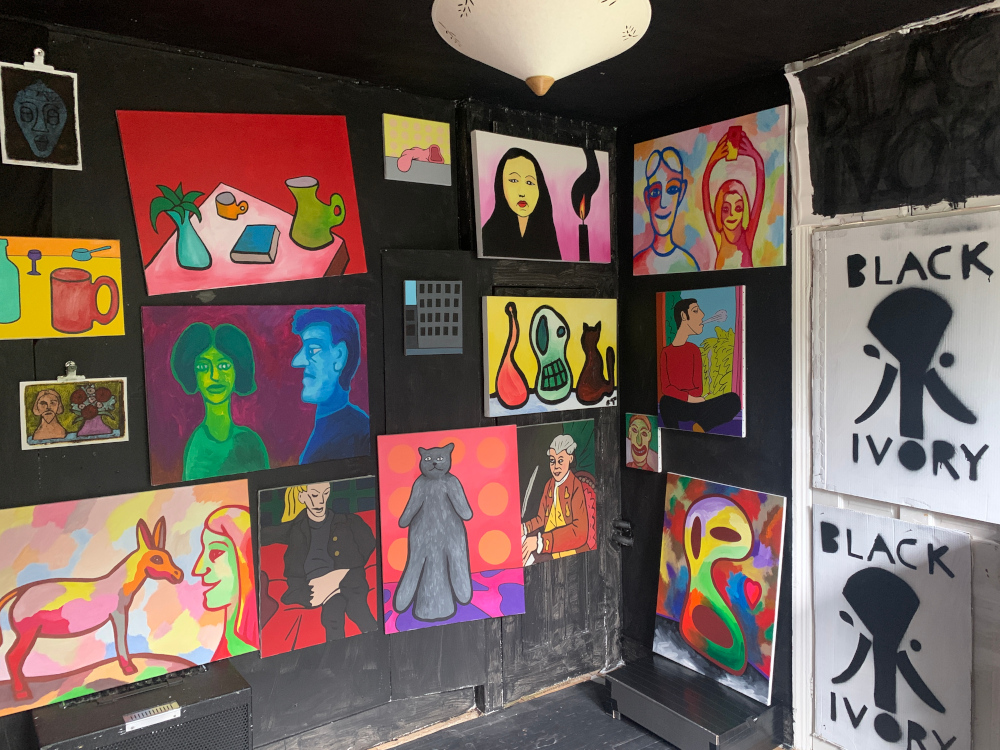
August 9th 2022 at “Heckel’s Horse Jr.” The first exhibition of Heckel’s Horse Jr. paintings, held at Black Ivory Printmaking & Audio Club in Muswell Hill, London. 

CT: I’d like to start with your name.

HHJ: For the purposes of this exhibition, my name is Heckel’s Horse Jr., but I’m aka Edgeworth Johnstone.

CT: So, we are here at the exhibition in…is there a name for this galley?

HHJ: Black Ivory Printmaking & Audio Club.

CT: Right, so do you want to say anything about the gallery, the situation, before we get on to the paintings?

HHJ: This room until quite recently, was white. You probably remember it as being painted white. And I decided to paint it black. As I was painting it black, it occurred to me that it took on quite a nice atmosphere. And it reminded me, for some reason of the Stuckist manifesto. So I decided it would be a good idea to host a load of exhibitions here. The first of which was a general Stuckist show…Actually, I don’t know at what point I decided to do multiple shows. I think it was actually after the Stuckist show, I thought I should start doing solo shows. And I’ve got a load of your work, so you were the first solo. And then I thought ‘Well. there’s no limits.’ because it doesn’t cost anything to do. So we can just do as many shows as we like of Stuckism, and it all started off from just painting the walls black. 

CT: I must say, I think this is great because people I’ve heard over the years often say ‘Oh, I can’t do a show.’ And I say, ‘Well, you’ve got a flat, haven’t you? You’ve got a house. You’ve got a bedroom. You’ve got a gallery.’ In fact, when I first started out, I did three print shows in America at various galleries in New York and Los Angeles. I knew people and they kindly renamed their living quarters a gallery for a week, and had some of my…So, we’ve got the gallery, which is an example to everybody in the world. Especially people that can’t get a gallery exhibition.

HHJ: You’ll do a better job of it anyway. They say ‘If you want something done properly, do it yourself.’

Heckel’s Horse Jr. aka Edgeworth Johnstone interviewed at his solo show, title Heckel’s Horse Jr,

CT: Did you know my mother?

HHJ: I spoke to your dad once very briefly, but not your mother. It’s funny because your dad thought I was Seb.

CT: That’s my son.

HHJ: Because, for some reason I picked up the phone in your house. I don’t know how it happened. It’s funny the ‘If you want something done properly, do it yourself’ thing because this is my way of showing the Heckel’s Horse work. It’s to just do them myself and then I can show them.  

CT: And this segways neatly into Heckel’s Horse. Shall we say who Heckel is to start with?

HHJ: Eric Heckel, one of the German Expressionists, who Billy in particular…I mean, I like Heckel as well, but Billy’s a big fan of his.

CT: Note to the audience: Billy is Billy Childish. Who we’ll come on to in a moment. 

HHJ: We started some group a few years ago 2014-15 and I think Billy came up with the name ‘Heckel’s Horse’ for the group. But at the time Billy and I were painting all these paintings together which we called ‘Childish Edgeworth’ because that was us. And then Steve, who works with Billy, came up with the idea of calling our partnership ‘Heckel’s Horse’. 

CT: Why horse?

HHJ: I think it refers to a picture that Eric Heckel did that I think Billy’s particularly keen on. To be honest I don’t know. I’m just guessing.

CT: You mentioned German Expressionism. Erich Heckel was a member of Die Brucke group, founded about 1905. Perhaps Ludwig Kirchener was the leading light of it and packed up after 5 years or so from disputes. But there was another German Expressionist group at the beginning of the twentieth century called ‘The Blue Rider’ which people might confuse with Heckel’s Horse. They might think the rider was on Heckel’s Horse but that’s not anything to do with it?

HHJ: No, as far as I’m aware.

CT: I should say for the audience who don’t know, Billy, being Billy Childish, who’s known for various things, particularly his music. He’s been namechecked by quite a lot of famous people including that guy from The White Stripes. Bjork, is it? 

HHJ: I don’t know about Bjork, but there are a few.

CT: A number of different people who are quite well known. He’s also an artist. A writer. He’s probably known as Tracy Emin’s ex-boyfriend if the truth be told, which is unfair because he’s got a lot more achievements than that. And actually, that fact that she once said to him ‘Your paintings are “stuck, stuck, stuck” because he was painting and she exhibited her bed…or she hadn’t done it by then but the sort of thing she was into. And he wrote that in a poem and in 1999 he read the poem to me and I said we should call ourselves ‘Stuckists’, and then the Stuckists art group was founded to promote figurative painting. That was 1999. You’ve founded a Stuckist group. There’s about 250 Stuckist groups in 50 countries around the world. 

Steve is the guy who runs the L-13 gallery near Clerkenwell/ Farringdon area of London. And the L-13 was named after a German Zeppelin bomber which destroyed some property in that area. I think the gallery was next door to the destroyed property. Anyway, that’s where L-13 comes from but it’s moved from that place. And they work together. Steve, at L-13 promotes Billy’s work. He also does stuff himself, doesn’t he?

HHJ: Harry Adams.

CT: There’s also Jimmy Cauty of the K Foundation. Burned a million pounds. Jamie Reid who did the Sex Pistols ‘Never Mind the Bollocks’ album. So that’s all the background that I didn’t really want to say, but anyway you got to know them. And you go down every Monday and work with Billy in his gallery. Billy’s gallery is a very large room that is in Chatham Dockyard.

HHJ: His studio, we’re talking about.

CT: Yes, I said ‘gallery’ did I? That’s his studio. You work there. Billy does very large paintings. 

HHJ: Huddie Hamper as well. He’s there every week.

CT: That’s Billy’s son. Billy does 8ft/ 10ft paintings in a couple of hours.

HHJ: Maybe not two but in an afternoon he’ll do a huge painting from start to finish.

CT: But the ones he does are a very different style. One could say he’s become quite academic. They’re drawn accurately, in terms of perspective and anatomy and so on. And they sell very well in galleries in Germany and New York but alongside those paintings there is another activity going on which he does with you. Would you like to tell us how that activity started and how it happens when you’re there together.

HHJ: Shall I start from the point where I was already in his gallery painting? Or I can start from where I first got in touch with him.

CT: Well start from the beginning.

HHJ: Now I’ve got to try and remember how it happened.  

CT: Well you went to L-13 the gallery and saw his shows and talked to him, I presume.

HHJ: Maybe a couple of words. Until he emailed me out the blue one day I’d said hardly anything to him. I’d met him a couple of times at L-13 but…he just emailed me. I think you said to me that you speak to him on the phone every now and then, to Billy, and you mentioned me. I guess he heard of me, probably, through you. I don’t know.

CT: I should say I’ve known Billy since 1979. We were in a group called The Medway Poets. Tracey Emin was a young fashion student and was going out with Billy. So yeah, we had had our ups and downs, but we’ve gotten on reasonably well for the last twenty years or so. 

HHJ: So I guess he probably heard of me through you and then he emailed me, and I ended up talking to him through email having not really ever spoken to him before. Only small talk at an exhibition and he said ‘You should come down one day.’ That was it. He wanted to see my paintings because I was showing him my work and he said ‘Oh, you should bring them down one day.’  So I did and he saw them and we had a chat and then he said ‘Is it quite a bother for you coming down here?’  he said one day. and I said ‘It’s quite easy.’ because I had a car at the time. I said ‘I can drive to Chatham in three quarters of an hour.’ And he goes ‘Well, you should come down the studio one day.’ So I went down the studio and I was working and he says ‘You know what you should do. You should get some big canvases’ because he thought it would be better for my work and this is funny because Billy didn’t know me and he just offered. It’s very kind of charitable. So he’s helping me out a ton and he says ‘You should get a load of canvases and we’ll put you up in my studio and I’ll give you a load of space because I think if you work bigger it’ll work. It will be better for your style of painting or whatever, because I was always working small because of my living situation. So I did that, but I think, before I got the canvases I turned up with a load of cardboard and I was doing a painting on cardboard that was a copy of a block print I’d done. It was a portrait of Picasso and it had a couple of birds on it. Sort of pecking his eyes out and stuff like that and he goes ‘Oh that’s alright but..’ he said ‘Can I…’. Did he ask? I don’t know. I think he probably did. He said ‘Wouldn’t it be good if it had a couple of lines.’ So I had three or four of these Picasso’s. They weren’t particularly precious or anything. They were on cardboard and he painted some eyes or a few white lines on them and it looked a lot better. And he goes ‘Ok, well that’s quite good.’ so then I start painting on these great big canvases. Like six foot canvases. And again, the same thing happened because it was very much kind of…Billy was kind of helping me sort of getting into a different area of painting so he would paint on them and the first one we did on canvas, that looked really good as well. So he goes ‘You know what, we should do a ton of…’ Well, he didn’t say to do a ton, but ‘We should do more of these.’ and we ended up just continually doing more and more and more because they’re so easy. They’re easy for me because I can just start and I don’t even have to bother making them look good. I just need to leave them in a good state for Billy. So I painted and he would come over and he’d do…and it was just so automatic and so sort of natural and they had a kind of look to them that neither mine nor his works do. They’re their own thing and it kind of snowballed and ten years, or nine years later, we’re still…to be honest since covid we’ve only done a couple. We’ve slowed right down recently.

CT: How many do you think you’ve done all together?

HHJ: I reckon between 150 and 200. 

CT: So you usually do one each visit, do you?

HHJ: Not anymore. No.

CT: When you were working before, at your peak.

HHJ: At our peak probably one a week. Probably averaged one a week.

CT: And you exhibited these at Pushkin House. What is Pushkin House and where is that?

HHJ: That was a group show. Pushkin House is in central London and is some centre for Russian culture. I don’t know exactly what their description is.

CT: Good job it’s not called Putin House. Anyway, sorry.

HHJ: I don’t know how that show came up because Billy and Steve tend to do the organising side of things and I hear about it later. 

CT: I just want to make the point that you have shown them there.

HHJ: We’ve been in three group shows. One was Pushkin House. That was the most prestigious of the three. We did one at Sun Pier House.

CT: That’s Chatham in Kent, near Billy’s studio. 

HHJ: And there was some show in Russia where they showed some Heckel’s Horse. Although I don’t think we were called ‘Heckel’s Horse’ at that point but some of them were showed over there. I don’t know. All I know about that…I looked on YouTube one day and saw my paintings being auctioned off, and no one told me they were selling them.

CT: This is the joint paintings was it?

HHJ: No, these were oil transfer drawings I did. I just saw on YouTube that my paintings were being sold, which was interesting. 

CT: So far so good. Now these are not actually Heckel’s Horse paintings. 

HHJ: No they’re not.

CT: They are your copies of…Oh, shall I, before I forget, are these Heckel’s Horse paintings for sale or are you keeping them privately?

HHJ: Keeping them. I’ve only done eight and I don’t really want to sell them.

CT: No, not these. I’m talking about the ones you did with Billy.

HHJ: I don’t know.

CT: Just for the viewers. We have a few millionaires knocking around.

HHJ: They’re not sort of…you can’t buy them online or anything and there’s no gallery showing them. But if someone was to ask I guess everything has a price.

CT: This is very amateur, by the way. Just in case anyone here thinks this is a professional job with a whole camera crew, sound recording, overhead lighting and so on and a van outside with masses of wires trailing out of it, it’s not. It’s just one camera on a tripod. Actually, they’ve probably guessed that by now anyway.

HHJ: I don’t think we were fooling anyone.

CT: We could pretend it’s a high end thing meant to look like a low end thing. Just to do a quick detour before we get onto the paintings, a detour about the video here. This is a homemade show. What about your videos? What’s the philosophy of the videos? How do you do those?

HHJ: Just film them. Put them on YouTube. Put them on social media. We’ve got an audience of like four people.   

CT: So it’s quadrupled since I last looked. That’s bloody good. You’ve gone up 400%.

HHJ: It’s kind of in keeping with the whole atmosphere of what we’re doing.

CT: Billy once told me that he did a gig in Germany and ten people turned up. They said ‘Look, we don’t expect you to play because you don’t have a proper audience.’ He said ‘You’re here. You’re the audience. We’re playing.’ And it turns out that one of them was an influential music journalist. 

HHJ: Yeah, you never know.

CT: Well does it matter? What’s the difference between having an audience of one and having an audience of ten thousand or a million?  

HHJ: Exactly.

CT: I mean, if you add noughts on the end. My experience of curating shows is that I do it because I enjoy seeing the paintings. Which is probably a selfish approach but means I don’t get het up and frustrated about who’s coming through the door and who isn’t. You know, if the people who are there enjoy it. Those four people really get something from it. You don’t know how it’s going to affect their lives and things tend to pick up later. When Cubism started there were only two people who knew about it. Picasso and Braques. Just two people. It’s grown a bit since then. 

HHJ: You never know.

 CT: So everything is homemade.

HHJ: Yes.

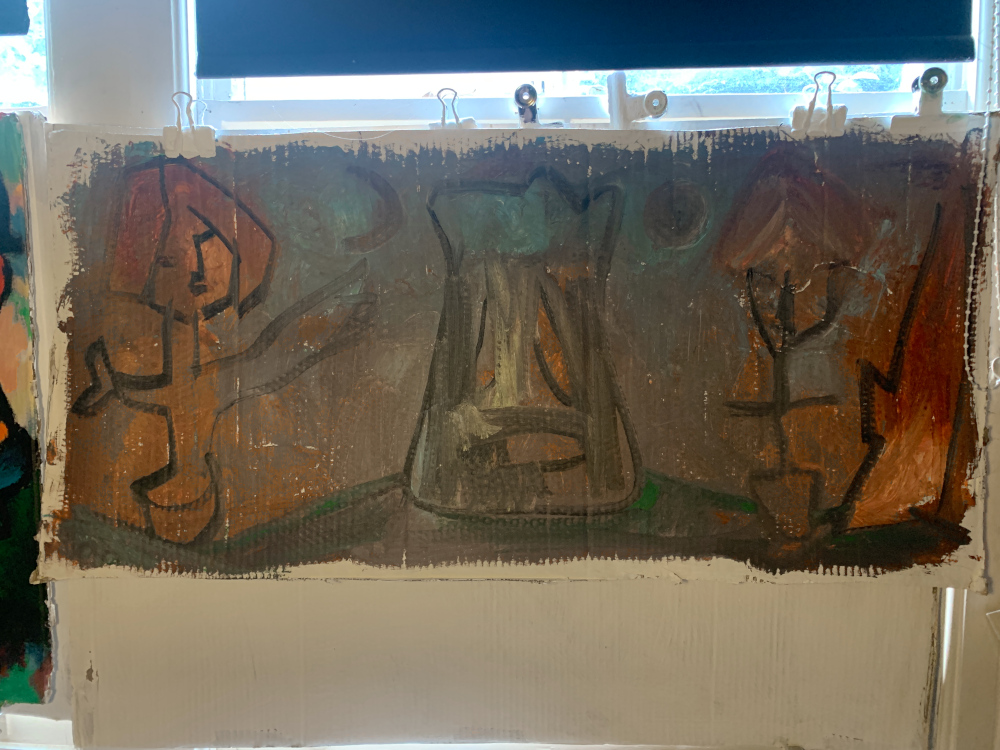
CT: Now, as I said, these are not Heckel’s Horse paintings. These are fake Heckel’s Horse paintings. Not fake perhaps. That’s not the right word. You have made your own copies of Heckel’s Horse paintings. These are your copies of the work you did with Billy. These are on cardboard. The ones you do with Billy are on canvas aren’t they?

HHJ: Linen, but yeah. Stretched Belgian linen. Well no, actually some of them are on canvas but most of them aren’t.

CT: For the viewers who don’t know the difference, it’s all the same. It just looks like a canvas, stretched. One is made from cotton and the other’s made from linen. But it don’t make any bloody difference does it really? Except for linen lasts longer than canvas. But the sails from Nelson’s Victory lasted quite a long time. They’re still there with lots of cannonball holes in them and stuff. They found them the other day. A couple of years. Or three years ago or so. Anyway, they’ve survived. Are the originals bigger?

HHJ: Yes, they are.

CT: How much bigger? Let’s take this one for example.

HHJ: That one’s a 6ft by 5 I think.

CT: This one’s about 40 x 30 or something and it’s your reproduction of a 6 by 5ft. So, quite a lot bigger. It’s like what, a quarter of the size? Why did you decide to do it this size?

HHJ: Just that’s what the materials are that I have. I didn’t need them to be big. 

CT: Why did you do them?

HHJ: Lots of reasons. I suppose the one main thing is I like them and I can do them. It’s not that I could….I definitely couldn’t do them without Billy, but I am sort of quite…

CT: No, sorry, why did you do these?

HHJ: Sorry, I’m not trying to say I couldn’t do the main Heckel’s Horse without Billy, when I say I’m quite interested to see what they look like when I just do them on my own. You know what I mean?

But also, I wanted to use this space to do the show. Some sort of thing for Heckel’s Horse because Heckel’s Horse…despite Billy and I always wanting to do a show, it’s never really been possible and I thought ‘Well, I’ve got Charles’s show up here.’ Which I did at the time. 

CT: That’s me by the way.

HHJ:  And the plan was, I think, for Jasmine to go next. 

CT: Jasmine Surreal. Yes, her paintings are down here actually. Next to me. 

HHJ: Jasmine Surreal was lined up next but I thought ‘I could take Charles’s work down now and get mine in quickly because I’ve got you, Ron Throop, Emma Pugmire, and I was thinking, ‘When am I going to do my show?’ because I want to get mine done. So I thought if I quickly took down yours I could do an Edgeworth Johnstone show. But then I thought ‘I’ve got no enthusiasm for doing an Edgeworth Johnstone show but what I would like to do is put up Heckel’s Horse paintings.’ But, obviously I can’t do that because they’re not mine. They’re me and Billy. So I thought ‘If I do them myself then I’ve got complete control and I can put them up.’ And I can not only do an art show but I can promote Heckel’s Horse, so more people learn about Heckel’s Horse and also for the artistic value in themselves. Hopefully do some decent paintings.

CT: So what’s this exhibition called? Who is it by?

HHJ: It’s called Heckel’s Horse Jr. and it’s by Heckel’s Horse Jr. A self-titled exhibition.

CT: Ok, so, let’s just take this painting. I’m familiar with some of the originals so I recognise these are the types of paintings you’ve been doing. The ones I’ve seen in Pushkin House, for example. But I don’t know them in intimate detail so could be fooled because they’re kind of like it. So if I put the original next to this, apart from the size what differences will I see?

HHJ: Not much. I have pretty much just copied them. This one, we did after a painting by Mikhail Larionov. We did quite a lot after Larionov who is a Russian painter from a couple of hundred years ago.

CT: Early twentieth century.

HHJ: Most people might know his…I don’t know if they ever got married, but his partner Natalia Gonchorova is quite well known. 

CT: Yes, is the highest selling female artist at auction, I think.

HHJ: He was Russian but there’s links with him and Picasso and that whole avant-garde crowd.  Billy and I did a load of paintings after Larionov and this is painted after the first Heckel’s Horse painting we did of a Larionov painting.

CT: Have you more of less copied a Larionov painting?

HHJ: No.

CT: Is it in the style of, or inspired by?

HHJ: Inspired by Larionov. So the Heckel’s Horse paintings that were done after Larionov are not copies. We use Larionov as a starting point but the end result looks quite a lot different. 

CT: I see, so the whole Heckel’s Horse project stem from Larionov’s inspiration?

HHJ: No we were already painting together before we started doing Larionov paintings.

CT: In the same style?

HHJ: Pretty much. I mean, we were already…

CT: So he just got hijacked and incorporated into it en route, and you moved on. Like a little bump in the road, and you carried on going?

HHJ: We didn’t stop, you know what I mean? We did them as well as. It’s like, instead of always doing a painting from, maybe a sketch or even just off the cuff, occasionally Billy would have this Larionov book and we’d go through it. We’d pick out paintings that we liked. But it’s not like we stopped doing Heckel’s Horse and we started doing something else. It wasn’t like a chunk of work in its own right. We just happened to do lots of Larionovs.  

CT: Yeah, but it’s not called ‘Larionov’s Lunger’ is it? It’s called Heckel’s Horse, so…Have you done the same thing with Erich Heckel’s work? Your own variants of that?

HHJ: I think we have. I think we’ve done maybe two or three. More Larionov’s than anyone else but we have done a couple of Heckel’s as well.

CT: It seems really that these people are just a catalyst for you to do your own work.

HHJ: Yeah.

CT: So if we get on to the paintings themselves. The first thing that you would notice about them is there is a figurative element. There’s often a person or people. Sometimes a horse. There’s a horse and person there. There seems to be a person in all the ones that are here. Is there a meaning? A narrative? A story? Or is it just a visual? Is it just that it works visually. Like you have a dream and you see things going on. Or are you thinking actually ‘This is a particular soldier.’ Maybe it’s Larionov in uniform, or something like that. Or maybe ‘He painted these Russian soldiers so we’re going to comment on that.’ Or maybe Kirchner of the Die Brucke Expressionist group was a soldier for a time. Does that come into it? Or is this me just projecting onto it things that I know. Am I meant to be doing this? Or is there a story that I should know, that you know. Or is it just a guy on a horse with a bit of a uniform?  

HHJ: As far as I’m concerned, there’s no real comment or meaning or requirement to know anything. They’re stand alone paintings that you don’t need to have any background knowledge to appreciate.

CT: Do you have any? Do you think ‘Ah yeah, this is reminding me of …’

HHJ: No. All I’m trying to do when I’m painting is do a good painting. There’s nothing else.

CT: Ok, well I’m going to challenge you a little bit on that because he is in uniform. It’s like a military uniform. Not like a contemporary, modern day soldier. Unless he’s dressed up in traditional uniform so you must have got that reference from somewhere. It’s not an accident. You can’t just do someone in a uniform without knowing that people wore uniforms.

HHJ: Well I’m just copying the painting.

CT: No, I’m talking about the original painting.

HHJ: What, the Larionov? It’s a painting of a Heckel’s Horse painting which was based on a Larionov.

CT: That’s what I’m getting at.

HHJ: And in the Larionov painting, that’s what the guy’s wearing.

CT: Yeah, so he knew he was painting a cavalryman.

HHJ: Larionov would have done, yeah.

CT: He definitely knew he was painting a particular soldier at that time in history. I presume it was just before the First World War.

HHJ: I don’t know.

CT: So he knew what he was doing but you’re not really bothered with that side of it at all.

HHJ: Not really. No. I mean, not at all. I like a painting to be a good painting. I don’t really mind the background story. 

CT: One of the things that’s said about figurative painting is that every figurative painting is an abstract painting. And you’re demonstrating that.

CT and HHJ are now holding one of the paintings from the show upside down in front of the camera.

CT: The reason I’ve done that…Kandinsky….well, he was doing these figurative paintings and he came in one day, and he saw this painting propped up with the most amazing colours. Completely abstract. And then he realised, it was one of his figurative paintings, of a landscape or something but that gave him the idea that he could just paint abstract without having to have a figurative work. A figurative image. And when you look at things in different ways. Like, shall we try it sideways as well? I mean, it works without even having to know there’s an image. Rather like Chinese calligraphy type paintings, where someone will do beautiful brush marks all over the surface and it’s that movement, that gesture that the brush makes which gives it the interest. And anybody that’s done something like that will know that you can do that brush mark and it can be very dull and prosaic, or you can do it and the variation, the pressure, and the dynamic and the direction it’s going in, the flow of the ink and so on comes alive. So I think it’s not just a question of painting the subject. It’s really how you paint it. I think, how you paint it comes from who you are. And I’ve thought about this quite a lot, before you have any art you have an artist and they’re going to leave their stamp on the painting. They can’t help it. If someone is a superficial person, they’re not suddenly going to find an amazing depth when they do a painting. If they do then they’re touching a deeper part of themselves anyway. But if they never access that deeper part of themselves, and unless it does come out despite themselves, if you like, their work’s going to be superficial. So every mark. Every colour. Every decision…I mean, conceptual art has very few decisions. Damien Hirst’s shark has one decision. I will get a shark and I will put it in formaldehyde. That’s the decision. Whereas take any of these paintings. Every square inch has got a different decision in it. There’s a red here that is slightly different to the red there. This band is a similar colour to that mark. That’s almost a rectangle of paint. This is a rectangle. A bit of a wonky one, but it’s a different kind of rectangle. I know I’m going on a bit here. You mentioned Jasmine Surreal. I did a big painting once. It was a ten foot painting. I’ve only done one that size. I wanted to get it out the living room but it’s got agitated brush marks all over it. Different colours. Different intensities.  And she looked at it and she said ‘Are you feeling more passionate, or anger there? And then you were feeling quiet…’ I said ‘You’re right.’ You could read the marks and the colours as if they were words and basically they are. We’re talking about language. It’s not one that our society, our culture is particularly skilled at reading. You know? We’re taught to read words but people are generally not taught to read images. Obviously sometimes they do it instinctively and they look at something and say ‘Oh, that’s good isn’t it.’ They’ve read the colour and the shape. Or they might say ‘That’s a bit bright.’ You know? The intensity is blinding. So there’s a primitive reading but not a very subtle and sophisticated one. And it’s like wine. You start out with a bad sweet wine and ten years later you turn your nose up at it because you’ve developed a palette. It’s like anything. The more you do it. Using words, for example. You don’t expect a five year old to have the expressive capability of Shakespear. It’s something you develop and become more sophisticated, more sensitive to, hopefully. If it’s going in the right direction. So what I’m saying is, in these paintings, there is a display of a lot of what I’m talking about. The feeling for the right colour, the right shape and the right place. 

Now to my mind, there’s a balance between what you’re painting and how you’re painting it. In abstract work obviously, it’s completely how you’re doing it because you’re not painting any specific subject and I think the interesting thing about figurative work is that tension between what it’s showing and how it’s showing it. Do you have any response to all of that?

HHJ: I don’t think people who look at paintings are aware of how much you’re considering as you’re doing them. Especially in my work that can look quite sloppy and I’m sure I’m talking for millions of other painters who…There’s a very deliberate move in everything you’re doing that’s totally beyond the concept. I know you started from saying Damien Hirst’s conceptual work was ‘Oh, it’s a concept.’ Well, who cares about the concept? You can start off with that, alright fine, but what I like in art all comes from that point onwards. And just that satisfaction you get from seeing things that look kind of balanced and correct in an abstract sense but it would have to be attached to something figurative for it to have any kind of hold on me. I couldn’t care less about abstract work at all. It has to relate to something in physical existence otherwise it just goes over my head, and I think there’s a balance there. I’m trying to do as much abstract work as I can in a figurative painting and having nothing else at all. Not having any concept, or meaning, or narrative. If you take all that stuff out you’re left with a more pure thing at the end of it.

CT: As soon as you do anything figurative you’ve got a narrative, whether you want it or not.

HHJ: I’m just trying to do stuff that just looks good. There’s not really any kind of emotion in it or need to express myself.

CT: At the end of the day, I particularly apply this to poetry, which I write a lot, which I’m doing at the moment. At the end of the day, what’s left is the poem and someone reads that, and that’s got to work. The poem has got to work. So I might write about my life in the poem and it might be something that’s particular to my life but it doesn’t sit in the poem because when you’re creating something I think there’s a dialogue between you and the thing you’re creating. It’s telling you what to do. This has happened to me quite a lot. With painting, for example, I’ve thought ‘Right, I’ve got a red there.’ I’m just speaking in general terms. Crude terms. ‘A red there. A green there. And I’ll put a nice yellow there.’  So I put the red there, and as soon as I’ve done that I realise the green’s not going to work and the painting’s saying ‘Hang on. This is your bright idea but look at it. It’s not going to work is it? Actually you need the yellow there.’ And then maybe, oh we need a blue up there and then later on the colour that I left out pops up down here, so it’s not lost. It comes up again quite often in a different form, so there’s that interaction. At the end of the day you’re creating something. You’re making something and if you’re sharing it, I think you have to consider who’s looking at it. Whether you do that consciously or unconsciously. Otherwise, what’s the point of showing it? If you’re not creating something that someone can look at and get something from, there’s no point in showing them.

HJJ: I feel like I don’t even have a choice when I’m painting. It’s almost like, it needs to be that and can’t be anything else, so I can’t even consider ‘If someone else sees it they won’t like it, so I need to try and do this, or try…I’m really at the mercy of what feels like the right thing to do.

CT: I think we’re actually saying the same thing. I’m not saying you should adjust everything because someone’s going to look at it. Because actually, that happens to me. I sometimes have an idea and I think ‘I could do this painting and it’s just too easy. It’s just too simple. People are going to think it’s rubbish. I don’t want to do it but I really want to do it. People are going to think it’s rubbish.’ So I just do it and then they come along and say they really like it, but that’s just me because I suppose I have a sort of awareness to what’s going on outside me. 

HJJ: You’re doing what feels like the right thing to do anyway.

CT: Yeah, but sometimes there’s a block. Less so nowadays I must say, but in the past more so. You don’t have that. But you talked about doing what’s right on the canvas, and that’s exactly what I’m saying, that it’s telling you something. 

HJJ: I was thinking this two days ago: I was doing a painting of a fish under a boat. I realised that I don’t have any choice. This is going to be a fish under a boat. I know if I come in with my bright idea it’s going to screw it up. You’re just following orders really.

CT: The one that we pulled down from the wall and showed in front of the camera. I’m facing that so it’s the one that’s easiest for me to look at. There’s a man that seems to be wearing a hat and there’s an animal of some kind. Is it a pig of some kind? 

HJJ: I think it’s a dog.

CT: But I get a feeling from it. It’s not unpleasant. I think just a few lines can be very suggestive. The man’s face. There seems to be a certain thoughtful quality to it. He seems to have stopped and be thinking about something. That’s something everyone can relate to. And the animals there. Again, you can relate to that. It seems to be absorbed in its own life. Mooching around the ground. Sniffing the ground. The man seems aware of it but not really relevant to him at that point in time. And he’s in front of a building. Looks like his house. So you’d think it’s probably his home and maybe it’s his garden. That sort of thing. You get a feeling for the whole thing but that could be done in a very illustrative way. In a kind of Norman Rockwell or something, and you wouldn’t get the same feeling from it though. You wouldn’t get the same atmosphere and the whole sketchy thing suggests a liveliness. Conveys a liveliness. A sort of spontaneity which makes it living, whereas a Rockwell is a very skilled illustration but it’s kind of frozen in time. 

HJJ: It’s as different to what I’m doing as making cheese or playing football. I know that technically, they are both called paintings, but other than that there’s nothing. I think there’s a lot of…art’s such an overriding term but so’s figurative painting. There’s figurative painters that are not doing what I’m doing at all and that’s not necessarily a good or bad thing. Even within Stuckism. There’s painters like Jonathon Coudrille, for example. He’s absolutely brilliant at what he does but me and him, for example, I don’t know what’s going on inside his head, but I just see it as completely different.

CT: But you have been exhibited, more or less, side by side.

HJJ: Yeah.

CT: Stuckism, the art group mentioned earlier, which I had the idea of and founded with Billy Childish to promote figurative painting. But my idea of it, from the outset, was a very big umbrella. So you’d have very expressionist work. Very highly polished work. Cubism. Pop Art. Figurative Pop Art. Realist art. All different kinds of styles. It wasn’t a stylistic thing. What was important was that the artist had a strong sense of authenticity. Of honesty to themselves of their experience of life and have the skill to communicate that in their own style. And really Modernism is the history of people inventing their own rules and their own styles. Van Gogh invented his own rules, which was that things could be wonky and distorted and would be painted in a very agitated, and often swirling brush marks to express all the energy he felt in the universe. Whereas another artist, obviously Picasso for example, chose to fracture things. He didn’t, in his Cubist period have the same…well he had some of the same brush marks, but not the same effect at all. It was more or less fractured plains. He was interested in a sort of…dissecting something and putting it back together again. But it worked in his terms. If you look at any of the Modernist artists whose work is successful, they’ve invented their own domain to work in. That’s Modernism, then we come on to Postmodernism where people plunder it. Or Remodernism, where we value it and try to develop it. 

HJJ: Any good art is authentic. Van Gogh said ‘Anything done in love is done well.’ I read the Stuckist manifesto and I think ‘That’s how I write songs.’ Whenever I’m doing anything, it’s just that feeling of authenticity and nothing else. Then what you’ve got will be original because despite the fact that there’s eight billion of us, we’ve all got individual handwriting. It will be original by default. You don’t have to try and come up with some clever idea to separate yourself from the crowd, which is what I suspect is going on in a lot of contemporary art, and the art at the time of the Stuckist manifesto. It’s a contrived originality. When I look at Van Gogh’s work, I don’t see someone who’s struggling for an idea, or came up with something. I just see someone who’s doing what he feels he has to do, and by default happens to have just made something that’s original. So going back to what I said about Jonathon Coudrille, maybe I was completely wrong. Maybe we’re essentially the same thing, just manifested very differently. Essentially it’s just two artists doing their stuff and there’s no other way it can be done or said.  

CT: I used to do a lot of teaching poetry at schools, freelance. I went round schools and performed and so on. I told the children in the class, I said, I want you to write about the thing you’re a world expert on. ‘I’m not world expert.’ I said ‘Yes you are. What did you have for breakfast this morning? What did your dad say? What did your mum say?’ Oh, this, that and the other. ‘Well, you’re the only person in the world that knows all that aren’t you? What was it like when you went to school? What did you see? Who did you talk to? How did you get here? You’re a world expert on that.’ And then they start trotting out ‘Oh yeah’ and this happened, and that happened, and suddenly you’ve got this whole treasure trove of personal experience. Or you could say to someone ‘What was the worst thing that happened to you? What was the best thing that happened to you?’ They come up with these extraordinary things and it’s all there in, so called, everyday life.

I totally agree with you about this striving in art for, so called, originality. What it comes down to is, trying to find a material that hasn’t been used for art and calling it art. So you find a shark that hasn’t been done in art, so you call it art. ‘Oh, that’s original.’ You exhibit a bed, like Tracey Emin exhibited her bed. ‘Oh, no one’s done that before.’ They had actually, but never mind. ‘Oh, you’ve made a sculpture out of bread.’   You make a sculpture of your head out of your own blood and freeze it. ‘Oh, that’s new isn’t it. That’s new.’  Well, what’s the difference between the sculpture of a head in blood in a freezer, and a sculpture in bronze? It’s got the same contours. It communicates…’Oh, it’s a concept.’ But it’s not actually a very interesting concept. Ok, you get it. You get the joke, or the cleverness being ‘Oh, that’s clever.’. And then once you’ve got it, it’s ‘Oh, it’s just a sculpture,’

HJJ: You could spend all night just coming up with arbitrary stuff like that, that has no depth to it and is new. I’m sure no one’s stuck an ironing board on top of a carrot and spun it on the head of a daisy. Is that a genius idea because it’s new?

CT: It is now.

HJJ: We could come up with a list of 500 by tomorrow morning and it’s all just complete nonsense.

CT: Of course, you’ve taken part in Stuckist demonstrations against the Turner Prize outside Tate Britain for several years, and that’s been going on for about twenty years. It’s stopped now because I got fed up with it. I was actually given a conceptual art award by the Proto-mu group for the demonstration against the Turner Prize. And, of course, if we said it was a conceptual art piece you would have been treated very differently.  My hope was always that it would be nominated for the Turner Prize.  So our demonstration against the Turner Prize would be in the Turner Prize as one of the nominees and simultaneously we could be outside doing a demo.

HJJ: We’d have to be. 

CT: Against our demo that was in there.

HJJ: I think I made a quick video today and said that that’s the best nomination I’ve heard.

CT: Is there any more that we should say about this? Just….how does this relate to your other work? Does your work with Billy relate to your other work? I have actually referred to Billy’s other work but perhaps you could say how it relates to his other work.

HJJ: These, pretty much, felt to me like doing my normal work, even though I was copying the Heckel’s Horse paintings. The Heckel’s Horse paintings are completely different to my work because I’m not in complete control. If I’m not in complete control, even if I really like the work, in a way, I almost really don’t care. I’m not being derogatory to the Heckel’s Horse, but when I’m painting them I can do whatever I want and leave it to Billy to sort the problems out.  

CT: Perhaps his other work, which goes in galleries, is more demanding in some way. Discipline and control, because it is very controlled work. 

HJJ: I don’t know. The Heckel’s Horse one’s are a discipline and a control in a different manifestation. It’s one of those things where, even though they look very loose, if one brush stroke is wrong we’ll change it.

CT: But it’s the difference between someone doing accounts, where every figure has to be precise, and it’s like again, and again, and again. And the discipline of going down a ski slope.

HJJ: I don’t know how Billy feels when he’s doing his own painting. Sometimes things can appear that they must be that way, but the experience of doing them… 

CT: I wasn’t saying Billy’s was like doing accounts. I was just drawing a distinction between how you can have a distinction between different types of discipline. Obviously, going down a ski slope very fast, you need discipline, but it’s a different kind of discipline. All I was saying is that there’s different kinds of discipline. Going down a ski slope is, presumably for most people, more enjoyable. Not everybody. Paul Harvey does incredibly detailed, meticulous work, would drive me bonkers and he enjoys it. He thrives on it. It’s him to do that. He finds it very therapeutic. Very fulfilling. I’ve done, when I was at Foundation, I taught myself to do quite meticulous observational drawing and paintings. A lot of it was mechanical. And then I ended up thinking, why bother when you can take a photograph? I say that a painting is like a photograph of the inner world, and a phonograph is a painting of the outer world. Because you can’t take a photograph like any of these.

HJJ: No, but, like I say, there are people out there that probably find my work…doing that mind numbing…but when you asked about relating it to Billy’s work, I don’t really know. You would really have to ask him.

CT: No, I’m more interested in how it relates to your work because you’re here. I just thought there might be a little gem here about Billy and…what has he said about you doing this work?

HJJ: I only done these a few days ago. Actually, I did see him Monday…

CT: No not this. All your work together. 

HJJ: What, about my work in general?

CT: No, no, your collaboration. What’s he said about the work you do between you?

HJJ: I think both of us are really…I think we both said these are our favourite paintings of any paintings. Which sounds quite big headed to say, but it’s the truth.

CT: If Picasso said he’d done something original, that’s fairly accurate. I mean, is that big headed? That’s ludicrous. If he’s said ‘Oh, it’s nothing. It’s not going to have any effect on the world at all.’ That would be a load of rubbish. 

HJJ: Exactly, you can either tell the truth or not. If it comes across as big headed then that’s too bad.  

CT: I don’t think so.

HJJ: It shouldn’t come across as big headed because you don’t have a choice. If you think that, you think that. I think Billy and I both rate the Heckel’s Horse paintings extremely highly, otherwise we wouldn’t have done two hundred of them. We wouldn’t have bothered. 

CT: You said that you start them. You bash something down. Excuse the word ‘bash’, but you create something. You put down what you feel like. Marks, presumably you’ve suggested there’s a dog, or a figure and a house, or whatever, or maybe not all of those things, but some of those things. It’s not just abstract marks.

HJJ: No, I don’t do abstract. I always paint figurative. I never paint abstract. 

CT: So you’ve got some kind of figurative image there.

HJJ: Always. Yeah. 

CT: And you said he comes along and works on it, and pulls it together.

HJJ: Usually that’s how it happens.

CT: But does it happen the other way round? Or do you then ever work on what he’s worked on?

HJJ: Yeah, I do.  Most of the time…

CT: And then does he ever work on what you’ve worked on? How many times could that happen?

HJJ: There’s one painting we did of a bullfighter with a bull on top of him, and we went back and forth at least five times. We ended up painting the same painting at the same time. I think we were both at a loss and then we turned it round, we kind of went all over the place. I don’t think there’s been another painting like that one.

CT: Did it work out in the end?

HJJ: It always does. That’s the good thing. Like with my paintings as well. 

CT: But did you have favourite bits of the painting and then he comes along and obscures it? Does that happen?

HJJ: No, because I don’t…

CT: Or vice versa? Does he sometimes get a bit disgruntled? ‘Oh that was a good mark there, and you decided you’d paint over it.’?

HJJ: Not that he’s told me.

CT: So it requires a lot of tolerance on both sides.

HJJ: Well, I don’t care anyway. I’ve never done a painting with Billy and thought ‘I hope he doesn’t  touch that bit.’ because the thing is, whether it’s good or not is all relative to what’s around it anyway. So a good thing there is only good if everything around it…so you know it’s all going to change anyway, so I don’t really care what he does. And anything I do, if I really liked it, I could just try and do it in my individual work

CT: I think we’re probably getting towards the end of the conversation. Does it feel like that? Normally at the end I think people say ‘How do you see it going?’ Where’s the future?’

HJJ: For Heckel’s Horse Jr. I think I’m going to carry on doing more because these were so easy and I like the results. Heckel’s Horse? I don’t know because we’ve kind of stopped. We haven’t really done any in..I mean, we’re talking in August 2022…

CT: But you go down there still?

HJJ: I still go down there, but we’ve stopped doing Heckel’s Horse paintings.

CT: What do you do when you go down there?

HJJ: I just do my own work.

CT: Oh, I see.Why?

HJJ: We just haven’t been doing them. 

CT: So do you think Heckel’s Horse has reached its end? Or do you just think it needs a break and you’ll get back to it again?

HJJ: I really don’t know. I mean…

CT: Watch this space!

HJJ: It’s been so long. It’s August 2022. Covid was what? 2020?

CT: Let’s end by blaming Covid.

HJJ: It’s Covid’s fault and Billy and I will get back on it asap.  

Join the Fan Club to receive our regular publications
(Free worldwide shipping included).

Watch our Weekly Instagram Live Video Podcast: Thursday nights at 7pm GMT.

Site managed by Black Ivory
Site Map | Instagram | Fan Club

Heckel’s Horse Jr. Exhibition | Edgeworth Johnstone

Site managed by Black Ivory
Site Map | Instagram | Fan Club

Click HERE for the official Heckel’s Horse Jr. webpage.

Heckel’s Horse Jr. exhibition talk

Read the full interview here.

Heckel’s Horse Jr. is the third in Black Ivory Printmaking & Audio Club‘s series of Stuckism exhibitions. Heckel’s Horse Jr. is ala Edgeworth Johnstone. Johnstone is a member of The Other Muswell Hill Stuckists.

Each painting is a copy of a Heckel’s Horse painting. Heckel’s Horse is a painting partnership collaboratin between Billy Childish and Edgeworth Johnstone.

Childish and Johnstone started painting together in 2013. Over the last nine years they have made over two hundred Heckel’s Horse paintings together. Nearly all these paintings are 6ft x 5ft or 6ft x 4 ft oil on inen.

Join the Fan Club to receive our regular publications
(Free worldwide shipping included).

Watch our Weekly Instagram Live Video Podcast: Thursday nights at 7pm GMT.

Site managed by Black Ivory
Site Map | Instagram | Fan Club

Charles Thomson interview at Mr. Stuckism

Site managed by Black Ivory
Site Map | Instagram | Fan Club

Charles Thomson interviewed at his solo show, titled Mr. Stuckism

Charles Thomson, Stuckism co-founder interviewed at the solo exhibition of his paintings, titled Mr. Stuckism.

2nd August 2022 at Black Ivory Printmaking & Audio Club in Muswell Hill village, London UK.

Interviewed by Edgeworth Johnstone of The Other Muswell Hill Stuckists.

CT: We’re sitting here in one of my very rare solo shows. I think this is the first one that I wasn’t actually part of the promotion of it. This is a show that just happened because of the work in the collection of you, Edgeworth Johnstone and I think it’s the second exhibition you’ve done here recently. The first one was a mixed Stuckist show including Billy Childish, Joe Machine and other people. So this is the first solo show. You have got quite a lot of my works, obviously. I’m surprised how many you’ve got because I know there’s a whole load more all hanging up the stairs. Or there were. And they were early works done in black lines and flat colours. Whereas nowadays I’ll paint much more fluidly, where there’s no black lines and no flat colours. Sometimes the lines disappear. And I think you’ve pointed out, there was a kind of initiation into a new way, a more flexible and fluid way of painting.

EJ: Are any of these paintings particularly personal to you? In terms of both artistically and your own life.

CT: It’s very hard to answer that question, to be honest. I mean, I think, not really. Not personal in my life. I don’t think there are. Perhaps, in a way, that’s the most personal one, because it’s the toy cat of someone I was in a relationship with.

EJ: That’s of SP Howarth, up there.

CY: Yes, I know it is. I’ll tell you exactly where he was when that was painted. Actually I’m working with SP now, with poetry. He’s really stopped painting and he’s doing poetry and acting. He went to Camberwell Art College and achieved the distinction of being kicked out of the painting department for doing paintings. Because he was told it was an ideas based department. And when he said his idea was to do paintings, they said that wasn’t acceptable as an idea. And actually I got him a story in The Times newspaper. About half a page all about it because it was such an outrageous situation. That’s in the early days of Stuckism and SP, and it’s actually round a friends flat that was just off Tottenham Court Road, Khatereh, and she let us use her address in Purcey Road because it was a prestigious address for Stuckism. I think this was after the demo we went on, in Trafalgar Square, against Rachel Whitread’s plinth. Because on the plinth she did a full sized cast in resin and turned it upside down and put it on top of a plinth.Which was very clever and very stupid, simultaneously. And we did a demonstration about that. Stella Vine was one of the participants, much to her chagrin later on, when she looked back.And there’s photographs of it at a press agency. I think it’s Getty Images.One of them has got photographs of her standing there with her Stuckist placard.But she can’t deny it.When I wrote an essay for the Stuckist Punk Victorian book, for the Walker Art Gallery in 2004, we had a big show there which went on for five months, the first section of my essay was called the Battle of Trafalgar because it was describing this event which took place in Trafalgar Square. It was an opening event with all these celebrities like Melvyn Bragg and Nicholas Serota and some artists. There was a normal crash barrier for the public to stand behind, where we were standing. So the ceremony was over. It had been unveiled. People had gone off the plinth, where the microphone was. And I thought, ‘This is too good an opportunity to miss’. And I don’t like doing these sort of things, but I thought ‘Well, I have to do this. It’s my duty’. So I climbed over the top of the crash barrier. Got on the plinth and started addressing the crowd through the microphone about the shortcomings of The Turner Prize. And all these celebrities were standing there listening. They didn’t have any option, until somebody had the bright idea, eventually, after I’d been speaking for two or three minutes, of turning the power off. It was videoed as well. It was on some cable TV arts programme, I think. Then afterwards, I was in the crowd and suddenly I saw this figure coming towards me. Like a destroyer approaching a submarine. It was Nicholas Serota, who was somewhat irate. He was very disgusted because he said I had used somebody else’s work for my own purposes. I was quite taken aback, but I thought I’ll use an art historical reference, because that might placate him because he didn’t look very happy. And I said ‘It’s Dada.’ I can’t remember what he said exactly. It’s in the book that he basically snorted and stormed off again.There’s a nice photo of him and me together having our interaction.

Now, wait for it. Wait for it. Wait for the absolute total hypocrisy. Recently, and we’re now in August 2022. I think it was a week or two ago so it’s still available on YouTube. They repeated, the BBC repeated on iPlayer, an Alan Yentob documentary about Cornelia Parker, and towards the end of this documentary it got on to one of her works where she had wrapped Rodins’s ‘The Kiss’ statue in a mile of string. I think it was a mile, anyway loads of string. Possibly a mile. Because that was the amount of string that Marcel Duchamp wrapped up a Dada or Surrealist exhibition. Like cobwebs. Like string everywhere. I think that’s maybe why she used a mile of string. Well, hang on a moment. Isn’t she using another artists work to promote her own work? Which is exactly the accusation Serota had levied against me, with such vehemence and outrage, and now he’s letting, because he was in charge of the Tate. He’s letting someone else do exactly the same thing that was so bad when I did it. So that strikes me as being double standards. Actually, what happened on this Yentob documentary was that the Stuckists came into it because there was a Stuckist demonstration. Now I have to say that I didn’t know anything about this at the time and neither did anybody I know. But apparently this Stuckist, I later found out was called Piers Butler who had founded the Notting Hill Stuckists. Because all Stuckist groups are independent. They do what they want. So it was nothing to do with me, but he, on his own volition had gone in. He’d got lots of couples standing around ‘The Kiss’ kissing each other while he started snipping the string off. So that was another Stuckist demonstration that we got publicity from which was nothing to do with us. Well, when I say us, I mean nothing to do with me because I’m usually involved in Stuckist things. I don’t have to be but I usually am. That’s quite funny. It’s like when Tate Modern opened. Somebody did some kind of demo which people attributed to the Stuckists, or thought it was the Stuckists doing it. So we got publicity for not even doing a demo or someone else doing a demo. Which, of course, we had had lots of demos, about twenty years worth of demos outside the Turner Prize. People were so familiar and so used to us doing demos that one year we didn’t do a demo and The Telegraph reported that the Stuckists weren’t demonstrating. And another we turned up and said we weren’t demonstrating, and handed out leaflets explaining that we weren’t demonstrating because it was so bad we couldn’t be bothered to demonstrate. Which I thought was an amazing piece of sort of ironic, sort of conceptualism, that fact that we were handing out leaflets saying we weren’t demonstrating. My ideal, my dream was always that our Turner Prize demonstrations would be nominated for the Turner Prize. So we could have the demonstration actually inside the Turner Prize as one of the four nominees while meanwhile outside we were demonstrating against the fact that we were nominated for the Turner Prize. But this sort of thing doesn’t seem to get through. It doesn’t appeal

EJ: They wouldn’t think of that. That’s too good.

CT: It’s too good.What amazes me is that, if you say ‘I’m part of the art establishment. I think you’re wonderful and I’m doing this, kind of, whacky thing’ They say ‘Oh, it’s so whacky and funny and ironic and clever.’ If you say exactly the same thing, with exactly the same mentality but say ‘I don’t think you’re whacky. I think you’re a load of wankers and I think you’re talking out your arse.’ Then they say ‘Oh, it’s pathetic. It’s infantile.’

There was a bit of a run in with Sarah Kent who was the art editor of Time Out, because she wouldn’t feature any of our shows.And a journalist rang her up and said, and she said ‘Oh, well we can only feature one if four shows.’ and the journalist said ‘Well they’ve got five opening tomorrow.’ And we made a fuss about it which was great because it got in the Evening Standard that Time Out is censoring the Stuckists.Which gets better publicity than if they’d actually reviewed us. So I think that rather pissed off the editor because the next thing, Sarah Kent turned up and was sort of forced to review our shows, and obviously tried to rubbish them.And she said that I’d obviously been looking…because she talked about my painting of Sir Nicholas Serota behind a large pair of red knickers and the speech bubbles in the painting saying ‘Is it a genuine Emin, £10,000, or a worthless fake? Or an imitation, or something.A worthless fake. This pair of red knickers. To do with the fact that Tracey Emin had exhibited her bed with knickers and stuff round it. And Sarah Kent said that this was sort of puerile, infantile, whatever humour.Well a few weeks after that Tracey Emin was on television complaining that an installation that someone was exhibiting did not contain her genuine knickers. But they were substituted for another couple of pairs of knickers.So I think, far from being puerile, it was quite prescient. It was prophetic. It’s actually what happened. So if what I did, in saying that in the painting is a puerile sense of humour, isn’t then what Tracey Emin did equally as puerile in reality?

Another thing she said was that I’d obviously been studying the work of Michael Craig-Martin. Well, first of all, I mean, I’d never seen Michael Craig-Martin’s work, originally, when I started working like this because he wasn’t around. I mean, Patrick Caulfield was around. Liechtenstein was around. And actually my original use of black lines was based on Cloisonnism which was the use of outlines and flatish colours in the nineteenth century by Van Gogh and Emile Bernard, and later by Ernst Ludwig Kirchener of Die Brucke of the German Expressionists from about 1905. That was my inspiration. Certainly not Michael Craig-Martin. And the other thing was, hang on a moment, because one of my early paintings of Stuckism…actually, I’d actually done it at art college, when I was there at Maidstone Art College, so we’re going back to  1978. I’d done Seurat’s ‘Bathers’ painting in black outlines and flat colours. So the men in it, a group of men by the river…it’s in the National Gallery. So the men, there’s one with a white coat. I just left it white. Anyway, it’s black outlines and flat colours, which I then repeated later because someone wanted a copy and I didn’t have one so I painted it again. Now when Stuckism was launched in 1999 and it featured on the cover of The Sunday Times Culture and there was a page and a half inside, it had a big reproduction of this painting I’d done of Seurat’s ‘The Bathers’ in black outlines and flat colours. Well, a few years later, I think it was The Sunday Times again, featured Michael Craig-Martin doing a version of Seurat’s ‘The Bathers’ with black outlines and flat colours. So hang on. Who’s been looking at who? And as far as the kind of jelly drop colours that he uses. Those kind of bright pinks and yellows and reds and stuff. Again, I’ve got paintings where I’d use these same colours in 1978 at art college. That was way before, as far as I know, he was doing that kind of stuff. And I got those colours from punk art. From The Sex Pistols ‘Never Mind the Bollocks’ yellow and pink, flurescent pink album cover. Because that was the kind of colours that were around with, sort of punk visuals. It was like fluorescent greens and pinks and yellows. That’s where I got those colours from. I don’t know why I’m saying all this, apart from the fact that, why the hell not. Because some people might find it vaguely…. You seem to be finding it…you being Edgeworth, the man behind the camera…seems to be finding it quite entertaining.

EJ: Yeah.

CT: I think there’s so many entertaining things in Stuckism. I mean, we ought to do a whole book of entertaining things.There’s another classic one, that. Again, this was when Billy was with the Stuckists. Now, he seems to think he was with the Stuckists for six months. It was actually thirty months, if you want to know. It was from January 1999 right up to July 2001 at the ‘Vote Stuckist’ show at the Fridge Gallery. That’s where he told me he was leaving.That wa s thirty months actually. Perhaps he’s not very good at maths, or perhaps he wishes it was only six months. Actually, he probably wishes it was no time at all. But he does like the manifestoes, well he half wrote them. You know, we co-wrote them.He’s always like….it’s kind of weird, someone who doesn’t like Stuckism that really likes the Stuckist manifestoes. Doesn’t matter anyway. I suppose he thinks Stuckism wasn’t a manifestation of the manifestoes. But it’s actually meant to be the other way round. It wasn’t that the artists were meant to come along, read the rules and then conform. It was meant…we were meant to be looking at what the artists were doing and then try and put that into some kind of manifesto.Anyway, it doesn’t matter. But it was when Billy was still in the Stuckists. Those early days, probably, it was probably about 2000. And the ‘Journal de Brasil’ the journal of Brazil, the national Brazilian newspaper decided to do an article on the Stuckists and phoned up The British Council. Now the job of The British Council is to promote British culture abroad. So, you would have thought ‘Great.’ You know, a national paper in Brazil wants to feature British artists. These are rebel artists. So let’s say ‘It demonstrates the plurality, the tolerance of our society and our culture.That we have a country where we have an opposition group that’s quite vociferous, quite rude about the establishment. About national figures. About the Director of the Tate Gallery. And this is part of our culture.And this is what democracy is. And this is what free speech is. And this is Britain. Good old us. You know, we’re not like these bloody repressive regimes that stop people and squash them, and don’t let them speak.Well, that’s what I would have said if I was this person in The British Council. So what does she say? ‘Oh, you shouldn’t do anything on them.’ Oh, wonderful. What a good example.’No, you shouldn’t do anything on them. They’re not worth doing.’ I can’t remember the exact reason.’but you definitely shouldn’t do anything on these people.’ You know. ‘They’re not good people.’ Something like that. ‘And furthermore, there’s only two people doing it. They’ve painted all the paintings between them, and they’ve made up these fictitious names like Wolf Howard and Joe Machine. They’re obviously not real names.They’ve made them up and it’s just these two people doing this whole scam.’ Anyway, I told Joe Machine that someone had thought I’d made him up and he wasn’t terribly impressed by that. Well the thing is, if you say to a journalist that wants to do an article ‘You shouldn’t do this article.’ You couldn’t think of a better way of encouraging the journalist to do the article. Furthermore, you’re likely to end up being quoted in the article. So this is a complete ineptitude. That’s what gets me. It’s not just that they’re doing this, they’re doing it badly. It was a great article. It was a big article about the Stuckists and possibly about how they shouldn’t do something on the Stuckists.

Another classic example is the whole scandal over the Tate’s purchase of its own trustees’ work, Chris Offili. They bought his work. That wasn’t announced in the press. What was announced in the press was ‘Oh, the Tate is buying this important installation called, what’s it called? ‘The Last Supper’ or something? Based on Christ’s Last Supper, except Chris Offili had painted all the disciples as monkeys.It’s a good job he’s black isn’t it,and not white. Because that’s something that really gets up my nose. I believe in equality. I believe in equality for white people as well as black people and yellow people, purple people. And people who are green with red stripes. And that really gets up my nose when, you know, you’ve got a ‘Get Out of Jail Free’ card if you happen to have certain qualifications.Which I won’t go into now because you’re probably not allowed to say it, you see. There’s a stifling of free speech and our democracy, our whole culture is based on the freedom of speech. For debate. For progress. And people have fought and died for that privilege. For that right. Nazi’s obviously did not want people, did not allow people to have free speech. You couldn’t descent. And if you did, you know, you ended up in a concentration camp. 

EJ: Yeah.

CT: And my relatives were involved in opposing the Nazis. You know, their youth was spent in…like one uncle’s in the fourteenth army in the Burma. Said he saw horrendous things. Another one was flying planes. Cargo planes. Thirteen set out and his was the only one that arrived.I mean, my mother was on anti-aircraft guns in, at the end of the war. The only plane they shot at turned out to be an American but fortunately they missed. But, do you know, she’s got veterans badges. She was in uniform. My father was preparing to invade Japan in a tank. And so on. So, you know, my very very immediate family fought and were prepared to give their lives to oppose tyranny. And of course, it starts out insidiously with people being criticised in the press. This is what happened in Nazi Germany. And then they were, sort of, forbidden to speak. It didn’t happen overnight. It happened salami tactics. You cut off one slice at a time. You do a protest against them. You have a gang. You ostracise them. You criticise them. You stop them…books coming out. You stop them from speaking at universities. You get them dismissed from their posts at universities. Well hang on a moment. Is this sounding rather familiar? Because it’s exactly what the Nazi’s did. I’d just like to point that out in case anybody is listening. If you’re actually using this tactic to stop someone whose opinion you don’t like, or you don’t approve of, that is exactly the tactic that the Nazi’s had. And it obviously escalated. Because when people want to make a point. When they want a change in society it tends to escalate. Because they can’t achieve that change immediately. It’s not going to happen overnight. That happened, well actually it happened with the suffragettes. Because they started, when they didn’t get what they wanted straight away they started doing violent things. Slashing pictures. The Rokeby Venus in The National Gallery. Then a woman threw herself in front of a horse during the horse race and was killed. Then they started posting bombs. One went through a letterbox in Gravesend and, as it happened, was diffused by a gallant sergeant of police. Bombs! Well, actually, if they just hung on a bit, waited, it all happened. During the First World War because the country needed women in men’s jobs and then…it changed the balance. It changed the dynamic. History changes things anyway. If you’re patient it will happen. 

The same thing happened in the sixties, and I was part of that. Peace and love. You want to change society. You want to get away from materialistic society. You want to bring in different ideals. Maybe spiritual ones. Maybe, you know, peace and love. And it sounds corny and stuff, but I mean it’s perfectly valid isn’t it? I mean the whole of Christianity, or a lot of it was based on it. A lot of it was based on something else with the inquisition and the crusades but what we think of as Christianity is peace and love. And so generally that’s not derided, whereas hippies are for some reason. I don’t know exactly… perhaps they should have dressed up as bishops. Mind you, they did dress up looking not much different to bishops.  But they wanted ideals. They wanted to change society. They wanted to change certain things about it. And again, there was this frustration because it wasn’t happening overnight. And it started becoming increasingly agitated. And I was taking part. I was taking part in demonstrations. And there was the angry brigade that actually were using bombs, or planning to. I think they might have planted a bomb, but certainly they were involved with…that was their solution. It was the same thing. Turn to violence. You turn to more extreme measures. Well, that seemed to be happening with the movements now. Which, of various kinds, addressing valid issues, I’m sure. I have no doubt that black people have an inadequate time in our society. There’s a rather interesting Evening Standard article, in Brixton. They went down one street, was a lot of white people. Another street, a lot of black people. Well, the white people are saying the police are great. All the black people were saying that they come in, invade our house every other day.  You know, we’re a perfectly respectable family. So, you know, I have no doubt that there’s racial prejudice. Yeah, sure. And I’ve no doubt that people with gender issues. You know, transexual issues and so on, have a bad time which they shouldn’t have. They should be perfectly free. To be respected. You know, and so on. In fact, one of the Stuckist artists is, I don’t know to what extent, but, he certainly stands out as being…well, he dresses in quite a feminine way. Sometimes in a goth way and he’s always worked in a garage.And it’s ok, you know, it’s ok.People accept him. That’s what should happen. I mean, but there are ways of addressing things that are best for everybody. Rather than just a small group that want to make a point because you’ve got to consider the whole of society. And maybe you’ve got somebody.who is a perfectly viable, maybe he’s very knowledgeable. Is a lecturer or a historian or a researcher, or somebody. Maybe he’s a politician, and people dig up some mistake that person has made. According to them, at some point in their lives. Maybe a careless word and suddenly they’re blacklisted. We’re not meant to say that, probably…they’re cancelled. And I think, ‘Well, that’s not very tolerant is it?’ Because it’s like implying you’ve got to be perfect. And that is really dangerous because psychologically, the only people that are perfect are the people that have got everything denied. And if it’s in denial and it’s repressed, it’s going to come out in the worst possible way. And I think the people that are making the most fuss, and are probably the people who are repressing the most stuff, They’ve probably got the most issues. And there was a lovely YouTube video I saw yesterday actually. It was this guy that dresses up in a Chinese hat and the Chinese robe. And he goes up to white people, I say white, you know, Western people they were. I think, all white people.And maybe there was the odd black person as well. They went up to them and said ‘What do you think of my costume?’ and they said it was appropriation. It’s disgusting.  You know, you’ve got no right to wear it. I’m appalled etc. etc.  Then he went up to Chinese people and they’re going ‘It’s lovely!’ ‘How nice you’re wearing our costume.’ ‘We like to see it. We like to see it more.’  They did the same thing with a Mexican hat and, you know, Mexican poncho, and all the Westerners, I don’t know, not even particularly woke people or anything, I don’t think, and they’re just…it’s like just ordinary Westerners. They tend to be on the younger side.And they’re saying the same thing ‘You’ve got no right to wear this. You just, you know, appropriating, demeaning somebody else’s costume. And he goes up to the Mexican people and they’re going ‘Yeah, fantastic! Brilliant. Love the hat. Looks really good on you.’ And I think there’s probably an awful lot of that. And I don’t like it at all. And I have written poems about it which I haven’t got on me, fortunately. That means I won’t have to read them out. I don’t think I’m quite ready to release them yet but, you know, there needs to be a counter-movement. Just as, actually, Stuckism was an artistic counter movement to bullshit. To pretentiousness. To manipulation of the whole art world. Which to a certain extent, doesn’t really matter because no one gives a shit about the art world. Apart from the people involved in it, but, it does deprive the rest of society of an art which would be more meaningful to them. And there’s proof of that. I mean, when Rachel Whitread had an exhibition of her stuff at Tate Modern, I’m sorry, Tate Britain, years ago. And what does she do? She does casts of things. She does a cast underneath a chair. Which is actually taken from Jeff Koons anyway, but it doesn’t matter. And then she’ll make a solid block out of what was, a space under a chair. And she did this with a room. So she did a cast inside the room. So normally, obviously, the walls are solid and the inside is a space. Well, when she did it, the inside was solid concrete, and the walls weren’t there. They were shown by indentations. She did an exhibition at Tate Britain and it had so little attention, they had to give away tickets. If you went to another exhibition that was on at the same time, you got a free ticket to hers. Because it was so embarrassing because nobody was interested in it. 

Now we had an exhibition, as I’ve mentioned, of the Stuckists at The Walker Art Gallery in Liverpool in 2004 called the Stuckists Punk Victorian. And it was a massive exhibition. It was meant to be two months. It ran for five. This was a big old gallery. Very high walls and we had paintings floor to ceiling. All around this. It was like walking into a cathedral of art. And they said it was really popular. They said all sorts of people. We’ve got students, school children, tourists, artists, you know, collectors, critics,  just town’s people. People coming, they were loving it because it meant something to them. I mean, there was a John Bourne painting, for example, of a family and I think they’re standing there. Maybe four people and there’s a father-looking figure with a cup of tea. I mean, somebody was saying ‘I wonder why he’s got a cup of tea and no one else.’ So they want….The people promoting conceptual art, for example, their big banner is ‘Oh, it makes people think. It makes people question.’ It does, but the thing, what it makes people question is why the fuck it’s there in the first place.They say ‘Why are you calling it art?’ You’re not questioning anything about life. You’re just questioning the people that are doing it. You know, why should we think anything of this?  It doesn’t mean anything to me. I’m not getting anything from it. Why is it so good?  What’s good about it? Whereas when they’re coming to the Stuckists show they’re actually engaging in a dialogue, through the painting about things which matter in their own lives. It’s like, well yeah, I mean I’m making this up, but it’s like ‘Yeah, my dad always has his cup of tea, doesn’t he, he doesn’t make me one.’ That sort of thing. You know, that’s just one example, because obviously there’s a whole load of different approaches to life in Stuckist work because it’s so varied stylistically and subject-wise. But the one thing that’s in common is that it is actually dealing with something. And in a way that people can relate to. You know, anything here, I think there’s really nothing here at all that you couldn’t look at and have a response that would mean something to you. Obviously, some would mean more. Obviously if you like funny looking cats, or kind of eighteenth century figures. Of like a donkey and a woman, you know, if you like that kind of sensitivity. Or someone’s that looking a little bit more, like sort of street cred. Whatever you want to call it. You would relate to different ones, but you could still relate to everything here. Or just like the man and the woman. You know, what are they doing? Why has he got this attitude towards her? They look as though there’s some little tension there. And obviously, tension in a relationship is something that most people can relate to. Or even just that one with just objects in the kitchen. You know, it maybe reminds you of your kitchen and you think ‘Yeah, I like my kitchen.I’ve got things in there. I like my mug. I like a bottle of wine or a saucepan. You know, I enjoy it. I cook the meal.’ and it’s kind of nice to see it and it’s kind of refreshing. The colours are upbeat.  They’re not depressing. It’s kind of a nice thing to look at. And that brings me to why I paint. And I realised this in 2001 because I asked myself ‘Why do I do it?’ And I was living in West Finchley, in my living room and it was a white wall. And on it was a painting. And I thought ‘I know why I paint. Because I’d rather see that painting there than a blank white wall. I would rather this thing that I’ve created existed rather than nothing existing. Because I feel better. And it seems to me that that’s a very good reason. In fact, it’s the only reason for art. I mean, if you don’t, or poetry or anything. You know, it’s not a religion. It’s not a duty. Some things are a duty, right? Some things, maybe you get a bit bored cleaning your teeth every day but you have to do it. Or maybe you have to do something for your parents. Or someone’s ill and you think ‘Oh no, I really don’t want to go down the pharmacy but they’ve got a horrible headache or it’s that time of the month and they’ve run out of bloody tampons or sanitary towels and I’ve been commissioned to go and buy them. Why me? I’m a man. But I really feel awful, but ok, don’t worry, I’ll go.’ You do things that you don’t want to do. Well, you don’t have to do art. You don’t have to do poetry. Anything like that. So why do you do it? And I would say because it enhances life. Now, one’s got to be very precise and careful about that definition of ‘enhances’. I don’t necessarily mean it’s going to make you feel happy clappy. I mean, Leonard Cohen said ‘Seriousness is deeply agreeable to the heart.’ What I’m saying is, it makes your life better. That might well mean that actually, it takes you to a more serious or even a very sad part of yourself. 

One of the most important things in human psychology is to be in touch with your emotions and feelings. And one of the easiest things to do, which one is encouraged to do from babyhood onward, is to deny and repress feelings, which is unhealthy. I went in to a lot of schools to do poetry, which is a place where you release what you really feel. And I said to a teacher ‘Well, you teach children that their feelings aren’t important, to deny their feelings.’  And they said ‘Oh no, of course we don’t.’ I said ‘Ok, fine. So you’ve got a maths lesson and the child says ‘I don’t feel like doing it’. So you say ‘That’s alright. Respect your feelings’ You don’t say that. You say ‘It doesn’t matter what you feel. You’re going to do it. This is the lesson.’ And sort of, the penny dropped. Oh, kind of ‘Yes we do.We tell them that their feelings aren’t the most important thing.’ And yet feelings are…people think feelings are wild and crazy. Well, if you do that to them, then they are.But actually, if they’re functioning properly it’s a rational hierarchical system. Because in thought you prioritise and you give value. Well you do that with feelings. You know, there’s something you have a strong feeling about, something you have an adverse feeling about, a negative feeling about. You give a whole structure. You could look round anything. I mean, I could look at all these paintings, just to take this example. I have a feeling about each of them. Well, to me, that’s not as important. It’s a bit more superficial. There’s another one that’s a bit deeper. Or anything. People that you know. You have feelings about them all. If you were to actually print out those feelings in a graph, you’d have some people at the top. ‘Oh, I have massive feelings towards those people.That person, negative feeling. Sort them all out.’ So feelings are very important. And one thing that art can do is take you to deeper feelings that you might have lost touch with. If you don’t do that. If you don’t learn and manage and be in touch with your feelings. Some people are naturally. Some people are the complete opposite.  I mean, Jung made a model of air, fire and water, basically that air is opposite to water, thought is opposite to feeling. So the people who are highly developed thinkers often have very immature feelings. And you can see that in that film with Marlene Dietrich in, with the…Professor is smitten with the showgirl. He loses everything. You often see this. People who are supposedly very rational, when their feelings emerge, they go to pieces. And it’s like when you see a policeman or a fireman and something, you know, they’re tough people. And then maybe they find a dead child in an accident, or something, and they break down. Because suddenly the barriers been smashed.It took something strong to do it, but when it smashes the feelings just pour out and they’re uncontrollable. Whereas somebody else who’s more in touch with their feelings would be able to accommodate that experience.They would register it, yeah sure, as for what it was, appropriately. But there’s kind of disproportionate feelings and there’s proportionate and appropriate feelings. And if you’re healthy you have integrated an appropriate…feelings for situations.So yeah, certain things are going to make you feel angry. Certain things are going to make you feel bad, in proportion to what’s going on. Whereas if something’s repressed, when it’s triggered off it can just blow up completely because the person doesn’t know how to deal with it. You know, it’s like you have to learn how to walk and to run. Well some people have to learn to work with feelings. We all have to learn to work with feelings. Whereas it can be the other way round. Some people are very dab with their emotions. They’re comfortable with their emotions. When it comes to thinking, they’re really intimidated. And they’re frightened of thoughts. Actually frightened of certain thoughts. They don’t know how to handle certain thoughts. That’s the other way round. So that can happen as well. 

So when I say that painting should make you feel better. It should enhance your life. I mean it should bring you to a better engagement with reality. And that’s one of the points of Stuckism, is truth. Billy and I sat down and we talked about it, and we tried to work out, well, what is spirituality? How does it work? And we thought, well actually the key to it is truth. Which doesn’t mean, necessarily, not telling lies. It doesn’t mean that. It means facing the truth in yourself and knowing what that truth is. At all levels. So there’s a material truth, for example, it might be that the fridge needs cleaning out. That’s a material truth. And maybe there’s an emotional truth. It’s like ‘I’m not happy with the relationship.’ You know,  but I keep on bottling it up. I keep on denying it. Well you need to accept that you’re not happy with it. Instead of pretending you are because things don’t work if you pretend something different to truth. And you can take that all the way up to spiritual truth. Whatever you might define that as. To metaphysical truth. To things that are beyond the meaning of life. The meanings, for example, of why you’re doing something. You’ve got to try and face the truth of that.  And maybe you’ll decide that ‘My life isn’t meaningful.I’m doing something that’s not meaningful which doesn’t satisfy me. There’s something wrong in my head with what I’m doing. I can’t square it.’ That makes things difficult because any time you question something and there’s an objection to it. Obviously it upsets the status quo. But when you work through that, the end result is beneficial. So it all comes into it. Into our thinking. And I think that one thing that’s clear is that before you have art, you have an artist. And whatever that artist is will translate into the art. So you can’t have a superficial person making profound and meaningful art. You can have someone who appears to be superficial but inside they’re not. But whoever that person is, is going to translate into the art. Art is a conversation. It’s a presentation. It’s a communication between the artist and the viewer. Just as any interaction does that. So that you meet with somebody….and I’ve found this, that sometimes I might be emotionally upset for some reason. Particularly in youth, when I was younger, I didn’t know how to handle things as well. And I talked to somebody and they’d make me feel worse. And I’d talk to somebody else, and I’d feel everything was ok. And that person embodied something.  Well, the same thing in art. What they embody will go into the art. Some art will make you feel life is futile. I must say, that was my experience with the Sensation exhibition at the Royal Academy of the YBA’s. The Young British Artists. Damien Hirst and so on. When I first went in, I thought ‘This is quite exciting. Novelty. Big. All these exciting different things.’ But the third time I went to the show, it’s like, ‘This is awful. This is like nothing. It’s not enhancing my life. It’s depleting my life.’ It’s superficial. It’s masquerading as meaning when it’s not meaning anything, particularly. It doesn’t have the soul in it. Whatever you might call the soul. The soul is someone’s emotional depth. And again, this is part of the thinking that’s fed into Stuckism. And I’m not saying that all my work embodies the ideal, because, actually ideals are not good things to embody anyway.But I think some of that, that I’ve experienced in life, will come through in some of the work. It’s like Van Gogh could paint a chair or a boot, and you feel that’s symbolic of some vibrancy. Some power in life that animates existence. All of existence. Even a chair or a boot. Right, any questions?

EJ: No. Just things that were occurring to me as you were talking. I was thinking of what I consider good or bad in anything I see. Whether it’s art or music. Well if it looks like the truth then I’ll like it. For example, Bob Marley. I don’t really like his music but I watch his videos all the time because it looks like somebody who’s just doing their thing. It looks sincere. It looks like the truth. And that’s essentially the differentiator between good and bad in art, if you go as deep as you can. I think with your work, whatever it is, it’s the truth. You said Van Gogh, and Van Gogh said ‘Anything done in love is done well.’ If you can see the essential core of it is good then the rest is almost superficial. So, that was just a thought that came to me while you were talking.

Those are a couple of paintings that Charles and I did, back in the day, as collaborations.

CT: Yes, I think about the only collaborations I’ve ever done in my life. Well, in artistic terms.

EJ: And I think you should take some credit here for these ones you did at print club, because this is a method you sort of came up with. Was it out of ignorance, of not knowing how to make prints, that you came up with this method?

CT: Everything I did at the print club was out of ignorance. Which was kind of good because…I don’t know….I had done some prints at art college, you know. Some litho, etching, silk screen, but those facilities weren’t available and everything was very makeshift. Here in this room. And I thought it might be interesting to try and make up some methods of making prints. With some information from you about how some of the things might work. But then I thought, ‘That’s given me an idea to do something else.’ Which I did. I mean, the first prints I did, I just painted on a bit of paper, squashed another bit of paper and pulled it off. Then painted the same colours in the same place, and put another bit of paper…so that was a bit crude but you’ve got to start somewhere. I think a lot of people have a problem with failing. And our society encourages that. It shows people up. It ridicules people. You know, if you say ‘I don’t know what that word means.’ I mean, I didn’t know what the word ‘marinate’ means. Which Jasmine’s never let me forget. Well, I don’t know that much about cooking. I know now it means to throw a pancake out the window. No, it doesn’t mean that. No, but she will ask things if she doesn’t know. And I’m pleased to say that there’s some simple words that she didn’t know either. People should ask. You should be encouraged to try things that you want to do. 

EJ: Again, it relates back to Stuckism. I think, that…specifically for SP Howarth and the like. Who have found themselves kicked out for asking the wrong question. And its like, no, you’re doing your thing. You know, your artwork isn’t dependent on whether it’s relevant to what the world’s interested in right now.Your art’s something more internal. 

CT: I mean, you could say, if you’re not asking the wrong question, you’re not getting it right. Because art, and particularly poetry, for example, but also in art. But because poetry is words and dealing with ideas and concepts as well, you can perhaps illustrate it more clearly. Because we’re more of a verbal than visual culture. The reason it’s been associated with a lot of controversy…is because it’s doing the thing you’re not meant to do.Why aren’t you meant to do it? Because it’s been denied by mainstream society. And it’s an unhealthy denial. It’s something that needs to be brought forth. And we’ve got quotes in the Stuckist literature from one of the Gnostic Gospels, from Jesus saying if you don’t bring things out, forth, it will destroy you. And the same with society. An artist…are that safety valve. That they express the thing which is basically from the unconscious. That’s why it seems new and startling. Because it is. Because to the conscious mind it’s like ‘Err, I don’t know what this is.’  And, of course, a small number of people with connect with it, but most people will be following behind. Lagging behind. It’s bringing into consciousness something which has been repressed, in an unhealthy way. Let’s take Wordsworth. I mean, he seems very safe writing about daffodils and country cottages. Well, at the time, most people don’t realise this, he was like the Sex Pistols. He was like the Johnny Rotten. He was writing about vulgar subjects. Vulgar things like peasants and cottages that were beneath art. Art should be historic and grand and mythological. It shouldn’t be writing about these people. And he was and that was shocking. But obviously it’s very healthy for society that these things should have a spotlight shone on them. And then it gets integrated into the mainstream. That’s just one example. Byron’s another classical example of someone who was shocking because he pointed out things which weren’t normally pointed out, but needed to be. There needed to be a freer discourse about things. Which he was writing about. And you can just see that going throughout. I can’t remember how we got on to this from the prints.

EJ: No, but Stuckism has been documenting a lot of stuff that would otherwise have gone undocumented. Were it not for Stuckism. This kind of idea that painting is dead. Painting is the medium of yesterday. Well, that’s not what actually is happening. So I’m always trying to tie it back to Stuckism, obviously. 

CT: If you’ve got Peter Doig who’s always recognised as a painter. Even throughout the period where painting was supposed to be dead, you’ve still got people like Francis Bacon, Lucian Freud and they’re all recognised. Leaving Peter Doig out of it, but the other people I’ve mentioned basically had a nihilistic philosophy. And that was an acceptable approach to art, nihilism. 

EJ: Yeah, so even within painting, as long as you tick one of those boxes then you’ll get through, but Stuckism is not really like that. You wouldn’t necessarily get your John Bourne’s or what have you because they don’t have, on a very shallow level, say yeah, this separates him from the bunch.

CT: It’s interesting because there’s a connection with Peter Doig because Billy Childish was at a London art college with him and they had become friends. You know, so on. There’s that connection, a certain overlap, but he, from what I know. Certainly in some of his best known works, tended to use photography. And it was like a comment on photography as much as anything else, which makes it kind of clever. You’re not just interested in the subject. You’re doing this kind of comment on different means of visual record. 

EJ: I know in the manifesto you say about the experience of seeing works up in homes. As opposed to just viewing them. Do you feel any of that at this show? That there’s an experience that you wouldn’t get if it was, maybe, in Tate Modern. Just from the environmental fact of it. 

CT: Definitely.

EJ: Just contrast how you might experience the paintings here. Because I know that we’ve all done shows in your typical white wall gallery. I’ve done them. You’ve done them. It is a very different experience. Maybe in good ways, some ways and bad ways other ways. But I was just wondering how you experience the contrast. 

CT: Well, strangely enough, most of the shows I’ve done and curated, as time went on, even more so, in spaces with white walls…I would like to point out I had the Stuckism Gallery for three years from 2002 that had maroon upstairs and green downstairs, so it wasn’t a white wall gallery.

EJ: And it was your home as well. With sofas and all that lot. 

CT: I am basically curating shows…because my interest in creating them was to see the art. Like, it wasn’t to sell the work but generally speaking, that didn’t happen very much. Because by the time I had organised the show I had completely run out of steam for doing commercial stuff. Which never really interested me.What I liked was seeing the work and bringing people together. Enabling them to see their work displayed and having attention, because that’s very encouraging for artists. And to see their colleges, the Stuckists. Part of a communal effort. And that was my interest. So you could say it was effectively, rather like what you’ve done here. I was doing that on that similar basis. I wasn’t thinking ‘Oh, right, the world’s press… well to start with there was more of that going on. But as time went on it lessened…the world’s press beating their way to the show. They didn’t end up doing that very much. And as I say, I’d run out of steam and by then I was a bit of a one man band. Because when we started out at the Gallery 108 in 1999, Joe Crompton was the gallerist, Billy and I were both there. He had his contacts. I was contacting people in the press. When you’ve got a small number of people working together, and they’re doing something, it’s much easier.  But eventually I was really doing everything. Well I wasn’t literally sitting there, manning the…I think you were doing some invigilation but I was doing all the organising. And that’s it. I had enthusiasm for doing the organising of the work but I never really enjoyed promoting stuff for the press and doing PR and all that stuff. Even though I’ve done an awful lot of it, quite successfully. Just because you can do something, and you can do it well and you can do it successfully, doesn’t mean it’s what you want to do. Or even that you should carry on doing. It was a means to an end. If Stuckism and the art could be promoted without me having to do all of that, I’d just click my fingers and say ‘Great!’ But it couldn’t. Wouldn’t have been. We wouldn’t even be here in this room, this small show where I’m the only visitor to date. I think Don Takeshita-Guy is threatening to come along. We wouldn’t even have this if it wasn’t for that press promotion. 

But you want to talk about Stuckism. You see, for me, I’m kind of jaded with talking about Stuckism because I’ve been doing it for 22 years and you get fed up saying the same thing. I mean, I used to work on a hospital switchboard. I was on there seven years part-time. And I calculated at the end I said ‘ophthalmic hospital’ a quarter of a million times. But eventually, when I walked away from work all my limbs were aching. As soon as I left the job all the ache went. So I’ve learnt to recognise that now. I’ve got no control over it. I mean, I went to art college, obviously, then I gave up art, got into poetry. I was doing children’s poetry. I was going round schools. I was earning a lot of money. Really good money. I went to 700 schools over thirteen years, but at the end of it, it was just like a money machine. And I thought, ‘This is not why I’m doing poetry.’  I was jaded. I was fed up with it. And I was very successful. I mean, you know, I’m in over a hundred anthologies for children. For Penguin and Oxford Press. I was doing really well.  And I got back into painting, and I had to give up the children’s poetry even though I was doing really well in it because I couldn’t do both at the same time.Because you’re doing children’s poetry, I mean, you get an editor getting in touch saying ‘I’m doing a book on ghosts for nine to eleven year olds.’ and you have to sit there writing half a dozen on ten poems. Well, that takes time and energy and I needed that time and energy for doing painting. Or promoting Stuckism, or whatever. I had to ease my way out of it. And I stopped doing it. I haven’t done any children’s poems for the last twenty years.  In fact, I didn’t do any adult poetry because before, when I was doing children’s poetry, I squeezed out all the adult poetry as well.  And then after twenty years, and this happened about three years ago, suddenly the tsunami happened inside. You know, the dam broke and I wrote about four hundred poems in a year and a half. I wrote as many in eighteen months as I had written in eighteen years. They’re the best ones I’ve written.

EJ: You tend to paint a bit like that don’t you. You just have an avalanche of paintings. Then a long period of nothing. Then another avalanche of paintings. 

CT: Yeah, phases of things. I’ll illustrate with the poetry, but it applies to the paintings as well. When I was doing this big outburst of poems about three years ago, I put everything I could to one side. Because one came after another, after another. I’d opened up the tap. And now I’ve had to switch the tap off. I could open it again and more poems would come out, but I’ve got to do other stuff. So when I went through a change in my painting, in 2013 I think it was, I put everything to one side, and some very interesting opportunities came up. New things came up, like at the time things came up and I thought ‘This could make a story. This could get in the national press.’  And I thought ‘I can’t do it because I’ve got to do the painting.‘ You know, if I get involved with that I won’t be doing the painting. And the trouble is, when you’re multi-functional, when you’re doing all sorts of things. Not just doing the painting. You’re doing the PR. You’re doing the press. You’re doing the curating. You know, you’re doing the timetables.  You’re sending out the emails. You’re doing all the secretarial, all the administrative stuff. You’re doing the whole lot, it takes over. It blocks everything out. So in order to be a painter I had to block all that out and not do any of it. And it worked. 

What’s really awkward and difficult is that recently I’ve had to do some commission work, and I’m not in a painting phase. So some of it’s taken ten times as long as it should, because I haven’t got it right. Because I’m not really, kind of quite in that zone. And also I’ve sort of defaulted back to an earlier style which takes loads of time, which I didn’t want to do. So I would say, if you like, I’ve got it a bit wrong in what I’ve done. The paintings are good, you know. I’m doing a good job on them. But for me, artistically, that’s not what I want to do. Next time I will do it differently because I’ll know what the mistake is.  And that’s another interesting thing in life. Often you have to make the mistake to know what it is. You have to get it wrong to learn why it’s wrong, because otherwise you won’t know it’s wrong. And obviously you didn’t know it’s wrong, or you wouldn’t have done it.

EJ: And the fruits of all your wrong labour will have their own value anyway. So you can’t go wrong really can you? Whatever you do.

CT:  Well, that’s something else as well because nothing’s wasted. I do believe that. I’m thinking of bringing out a book called failed relationships. Of poems, called ‘Failed Relationships’. Because most people’s relationships have failed, aren’t they? In conventional terms because people don’t stick together. And actually people that do stick together, sometimes their relationships aren’t very good anyway. So is that a failed relationship? I mean, you could say ‘My parents stuck together their whole lives. Probably sixty years. But there was stuff underneath the surface. There was tensions. There was issues, you know. So is that a successful or a failed? These are just values you put on things. To me, everything’s an experience and I’ve…I’ve talked to somebody about that recently. They said ‘Oh, I’ve mucked up my life’  I said ‘No you haven’t.Because through doing this you’ve got an awful lot of depth of experience. Of knowledge and insight into various things that you wouldn’t have had if you’d just had a superficial easy life.’ I said ‘You haven’t mucked it up at all.You did what you could at the time and now you’ve left that behind and you’re in a different phase. Suddenly you’re free from that. But what you’re now thinking of doing, some creative work. Some writing or whatever, you’re talking about actually using that material. So obviously it’s not wasted.’ I mean, there’s a lot of things. Simple things that society should change.   

Join the Fan Club to receive our regular publications
(Free worldwide shipping included).

Watch our Weekly Instagram Live Video Podcast: Thursday nights at 7pm GMT.

Site managed by Black Ivory
Site Map | Instagram | Fan Club

Mr. Stuckism | Charles Thomson Solo Exhibition

Site managed by Black Ivory
Site Map | Instagram | Fan Club

Mr. Stuckism is a Charles Thomson solo exhibition at Black Ivory Printmaking & Audio Club.

Charles Thomson interviewed at the solo exhibition of his paintings titled, Mr. Stuckism

Read the full interview here.

Video tour of Mr. Stuckism. A Charles Thomson solo exhibtion at Black Ivory Printmaking & Audio Club.

Black Ivory Printmaking & Audio Club present

Mr. Stuckism

A Charles Thomson solo exhibition

Charles Thomson co-founded the Stuckism art group in 1999 with Billy Childish, who left in 2001.

Exhibition curator, Edgeworth Johnstone: ‘Mr. Stuckism is the first in a series of Stuckist solo shows at Black Ivory Printmaking & Audio Club in Muswell Hill, London. This series follows immediately on from our Stuckist group show, titled Stuckism.
Mr. Stuckism was conceived and hung on 20th and 21st July 2022.
Mr. Stuckism includes two collaboration paintings by Thomson and Johnstone.

Black Ivory Printmaking & Audio Club is a private members club in Muswell Hill village, London, UK. It was founded around 2013 by Edgeworth Johnstone. It is now also a black wall gallery in direct response to the Stuckist manifesto.

Mr. Stuckism a Charles Thomson solo exhibition at Black Ivory Printmaking & Audio Club. Photo: Edgeworth Johnstone 21st July 2022.

Mr. Stuckism a Charles Thomson solo exhibition at Black Ivory Printmaking & Audio Club. Photo: Edgeworth Johnstone 21st July 2022. The art gallery was painted black in order to adhere as strongly as possible to the principles of the Stuckist manifesto.

Mr. Stuckism a Charles Thomson solo exhibition at Black Ivory Printmaking & Audio Club. Photo: Edgeworth Johnstone 21st July 2022. View from below of the main painting area.

Mr. Stuckism a Charles Thomson solo exhibition at Black Ivory Printmaking & Audio Club. Photo: Edgeworth Johnstone 21st July 2022. Notice the two small works on paper. Both made at Black Ivory Printmaking & Audio Club before the audio part.

Mr. Stuckism a Charles Thomson solo exhibition at Black Ivory Printmaking & Audio Club. Photo: Edgeworth Johnstone 21st July 2022. Note the rare deep edge to the two paintings Thomson painted in Black Ivory Printmaking & Audio Club in early 2013.

Mr. Stuckism a Charles Thomson solo exhibition at Black Ivory Printmaking & Audio Club. Photo: Edgeworth Johnstone 21st July 2022. Note the similarity between the double portrait and the composition of many of Thomson’s still life paintings.

Mr. Stuckism a Charles Thomson solo exhibition at Black Ivory Printmaking & Audio Club. Photo: Edgeworth Johnstone 21st July 2022. Note the portrait painting of SP Howarth.

Mr. Stuckism a Charles Thomson solo exhibition at Black Ivory Printmaking & Audio Club. Photo: Edgeworth Johnstone 21st July 2022. The small painting is after a Billy Childish painting.

Mr. Stuckism a Charles Thomson solo exhibition at Black Ivory Printmaking & Audio Club. Photo: Edgeworth Johnstone 21st July 2022. Thomson psychedelia.

Mr. Stuckism a Charles Thomson solo exhibition at Black Ivory Printmaking & Audio Club. Photo: Edgeworth Johnstone 21st July 2022. The small condom painting is one of many Thomson condom paintings of the same palette and size.

Mr. Stuckism a Charles Thomson solo exhibition at Black Ivory Printmaking & Audio Club. Photo: Edgeworth Johnstone 21st July 2022. The mask is one of many hand-made one-off oil paint prints Thomson made of this image.

Mr. Stuckism a Charles Thomson solo exhibition at Black Ivory Printmaking & Audio Club. Photo: Edgeworth Johnstone 21st July 2022. The hang is slightly wonky as it uses the same nails as the previous exhibition.

Mr. Stuckism a Charles Thomson solo exhibition at Black Ivory Printmaking & Audio Club. Photo: Edgeworth Johnstone 21st July 2022. The Black Ivory door panels are a permanent feature of the Black Ivory Printmaking & Audio Club.

Mr. Stuckism a Charles Thomson solo exhibition at Black Ivory Printmaking & Audio Club. Photo: Edgeworth Johnstone 21st July 2022. The gaffer taped Sainsburys cardboard box the skull painting is sitting on was custom made for this exhibition.

Mr. Stuckism a Charles Thomson solo exhibition at Black Ivory Printmaking & Audio Club. Photo: Edgeworth Johnstone 21st July 2022. A collaboration painting by Charles Thomson and Edgeworth Johnstone.

Mr. Stuckism a Charles Thomson solo exhibition at Black Ivory Printmaking & Audio Club. Photo: Edgeworth Johnstone 21st July 2022. A collaboration painting by Charles Thomson and Edgeworth Johnstone.

Edgeworth Band rehearsing at Mr. Stuckism

Join the Fan Club to receive our regular publications
(Free worldwide shipping included).

Watch our Weekly Instagram Live Video Podcast: Thursday nights at 7pm GMT.

Site managed by Black Ivory
Site Map | Instagram | Fan Club
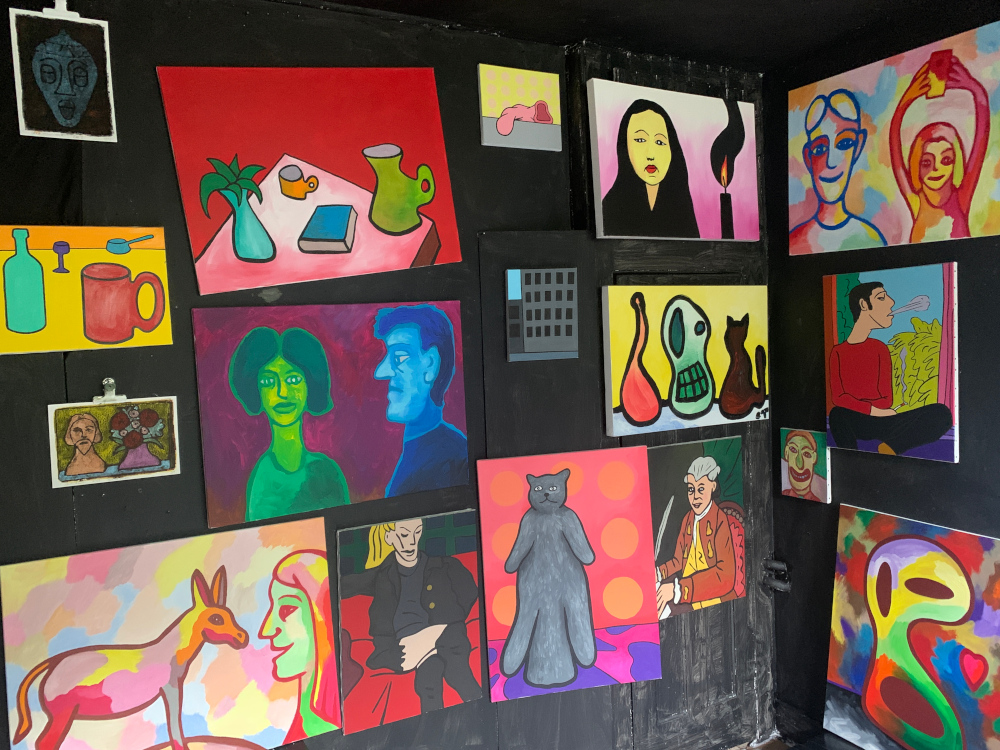
Jasmine Surreal and Charles Thomson Performance Art

Site managed by Black Ivory
Site Map | Instagram | Fan Club

Recorded in East Finchley, London, 24th May 2011.  Jasmine Surreal and Charles Thomson performing. Edgeworth Johnstone on guitar. All three are in Stuckism groups. This was all the same day and part of the same event as Charles Thomson Poetry Readings.

Jasmine Surreal and Charles Thomson, Edgeworth Johnstone on guitar.

Jasmine Surreal and Charles Thomson performing, Edgeworth Johnstone off-camera on guitar. Neptunes Funny Trident.

Jasmine Surreal and Charles Thomson.

Join the Fan Club to receive our regular publications
(Free worldwide shipping included).

Watch our Weekly Instagram Live Video Podcast: Thursday nights at 7pm GMT.

Site managed by Black Ivory
Site Map | Instagram | Fan Club

Charles Thomson Poetry Readings

Site managed by Black Ivory
Site Map | Instagram | Fan Club

Charles Thomson poetry readings. Recorded in East Finchley, London, 24th May 2011. Cameos from Jasmine Maddock and Edgeworth Johnstone. All three are members of Stuckism groups. These recordings were made the same day, and as part of the same event as Jasmine Maddock and Charles Thomson Performance Art.

Is it art? by Charles Thomson Left to right: Jasmine Maddock, Charles Thomson, Edgeworth Johnstone.
Charles Thomson performing his poem about Equivalent VIII by Carl Andre.

Charles Thomson, Stuckism co-founder reading his handy guide to the art world, and how to spot a fake Damien Hirst.

Charles Thomson performing The Dr. Who poem.

Charles Thomson performing his poem The Tube Train. Background voices Jasmine Maddock and Edgeworth Johnstone. End singing by Jasmine Maddock.

Join the Fan Club to receive our regular publications
(Free worldwide shipping included).

Watch our Weekly Instagram Live Video Podcast: Thursday nights at 7pm GMT.

Site managed by Black Ivory
Site Map | Instagram | Fan Club

The Other Muswell Hill Stuckist Newspaper

Site managed by Black Ivory
Site Map | Instagram | Fan Club

Join the Fan Club to receive our regular publications
(Free worldwide shipping included).

Watch our Weekly Instagram Live Video Podcast: Thursday nights at 7pm GMT.

Site managed by Black Ivory
Site Map | Instagram | Fan Club
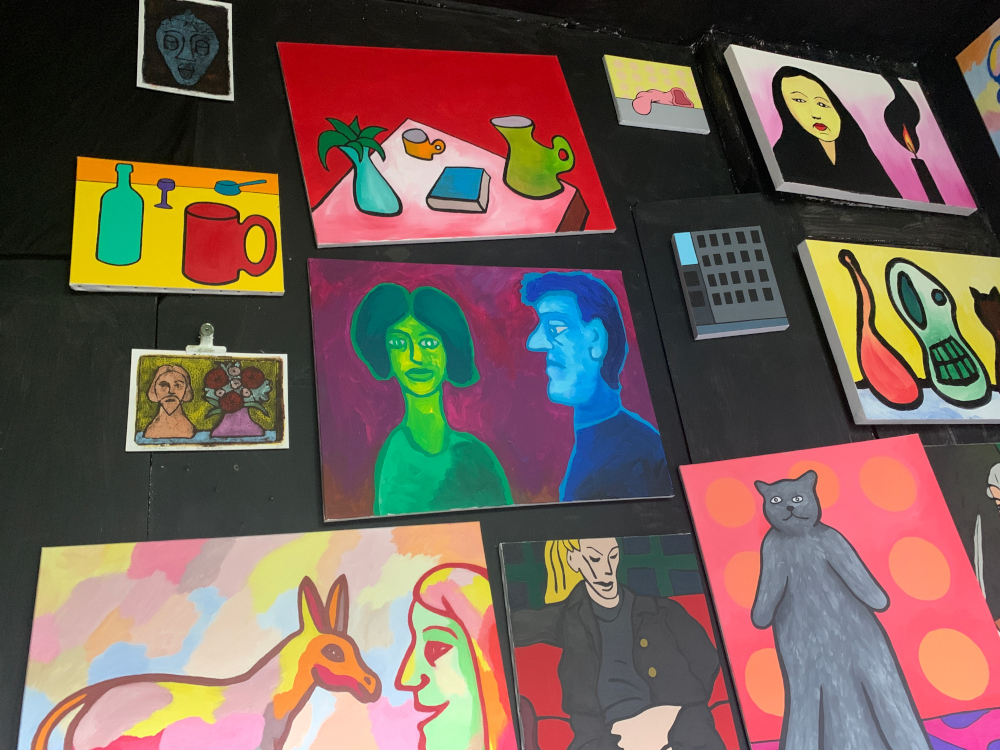
Edgeworth Band Live at Stuckism Exhibition

Site managed by Black Ivory
Site Map | Instagram | Fan Club

Both members of the band Edgeworth Band (Edgeworth Johnstone and Emma Pugmire) are also members of The Other Muswell Hill Stuckists. They played live at a Stuckist exhibtion titled Stuckism at Black Ivory Printmaking & Audio Club on 23rd June 2022.

Join the Fan Club to receive our regular publications
(Free worldwide shipping included).

Watch our Weekly Instagram Live Video Podcast: Thursday nights at 7pm GMT.

Site managed by Black Ivory
Site Map | Instagram | Fan Club

Stuckist Collections & Tate

Site managed by Black Ivory
Site Map | Instagram | Fan Club

First published in The Other Muswell Hill Stuckist newspaper, December 2012.

Charles Thomson (Stuckism co-founder) and Edgeworth Johnstone (of The Other Muswell Hill Stuckists) discuss Stuckist Collections & Tate.

EJ: At first I didn’t really understand why the Stuckists were opposing anything. I thought, why do they bother? They should just do their own work. And the more I got to know about it, and the more I got to see the missed potential within the art establishment to recognise such good artists. I mean, painters like Philip Absolon, Joe Machine…it would be so good for British culture, I think, if we had these artists around in galleries. Not always necessarily national galleries, but maybe at least some of the big name private galleries, in front of just people. I really got that side of Stuckism as well. The positive opposition to the art establishment. So you kind of get both sides, as time goes on.

CT: Yeah, that’s one of my bugbears is the Tate, which is a national gallery, and it’s funded by the public, and it’s run like it’s a private gallery. When Stephen Deuchar became the Director of Tate Britain, in 2000 I think it was, he said if you wanted a comprehensive overview of British art, or of art made in Britain, then this will be the place to come. That’s never been fulfilled. It’s not comprehensive at all. It’s highly selective. And when Julian Spalding ran a campaign for Beryl Cook to be in the Tate collection, it was ignored. Now, I’m not saying Beryl Cook’s my favourite artist, because she’s not. But obviously, a lot of people do like her. And those are the people that are paying for the gallery to exist, and they can’t go along and see her work there. Why not? Jack Vettriano is hugely popular as well. And again, he’s someone that has his supporters and isn’t included. Again, why not? In fact, why aren’t the Stuckists there? There’s lots of people that aren’t in there. John Keane is a figurative painter for example. The representative, leading artists of the Federation of British Artists aren’t in there. People like Ken Howard, who has sell-out shows, is a very accomplished painter. Fred Cumin, Bill Bowyer, people like that. And who’s the one that does the big female nudes, that Saatchi patronised? I can’t remember her name. 

EJ: The one in Sensation?

CT: Yes.

EJ: Can’t remember her name.

CT: She’s not in there either, which is kind of bizarre. And then when you see what is in there, what does get bought, you realise it’s actually far from comprehensive. It’s a narrow, very narrow, very selective take on contemporary art. Very narrow minded, and very prejudiced. Very partial to certain aspects of the fashionable which are basically promoted by commerce. By the certain leading galleries. By auction houses, and funded by people with more money than sense. And the Tate is now doing exactly what it did in previous decades. Namely, the Directors choice of a small area of art. Not representing the whole picture. And later people turn round and say ‘Wow, this guy, this past Director really got it wrong when he turned down, when he could have included it.’ And I think exactly the same thing is happening now. This current Director is making exactly the same mistake as in the past. And people turn round in the future and say ‘Wow, what a mistake.’ The same thing.

EJ: Yeah, and I think in a way it’s even worse. Because it’s actually a British art movement. It’s obviously, like previous Directors, in your article, you pointed out ‘The Red Studio’ by Matisse. It could be hung in Tate Modern today, if it wasn’t for the Director having his own personal angle and not buying it. Regardless of what was best for the country. Obviously Matisse wasn’t English, he wasn’t British. And to have, really, the only art movement around that’s doing anything like Stuckism. Being, for once, a British art movement, probably the major one in the world, I think. In terms of really getting on with Modernism and following it up. And it’s just a real refusal to have it in. I mean to turn that Walker Gallery donation down, is just insanity really, when you think of what that represented. I mean, a once only chance to get a good early collection of Stuckist work. To get that kind of work together again, would be extremely difficult. And it’s gone now, the public don’t have it, because this guy decided it wasn’t his thing.

CT: Well, Jenny Saville was the name I was looking for earlier on, who’s not represented. I keep on finding more and more people that aren’t represented. But going back to past Tate Directors. James Bolivar Manson said that Henry Moore would be in the Tate over his dead body. And Sir Nicholas Serota hasn’t said exactly the same about the Stuckists, but simply said they are not sufficiently accomplished to warrant preservation in perpetuity in a national collection. Sounds really just the same thing. History repeating itself. But let’s move on from the Tate, because the Tate follows, it has done in the past. Usually too late, so it will have to follow again when it’s too late. We’re not too late, I’m mean we’re here now. Fortunately I’m in a position of being able to have that experience. That cultural experience. That art which is meaningful, which the Stuckists are doing. And it’s on the basis of my experience that, and how much I’ve gained from that, that motivates me to try and disseminate it. Because I know what it’s brought to my life, and how it’s enriched my life. And I think it would be good if that could happen with more people. 

EJ: That’s it. I mean, I keep on seeing people keep churning out such good work in Stuckism. It’s just impulse to want it out there for people to see. 

CT: It’s like if you were around in the nineteenth century when people were doing their work and being ignored. Or when Van Gogh was doing his work and being ignored. Or any of the people who initially were creating something which the establishment turned down and rejected. You can it’s the same thing happening again.

EJ: It’s frightening to think that had things not changed with Impressionism, a lot of Cezannes could have ended up in a skip. If there are people in high places that have their own agenda, which obviously Sir Nicholas Serota’s announced. He’s got an anti-painting, anti-sculpture agenda, you will have masterpieces in skips if these people are allowed to run riot with the national collection, and the art scene. 

CT: But fortunately, just as there were with Impressionists, and later with people like Matisse and Picasso in their early days, there are a small number of enlightened and perceptive private collectors, who are doing very well for themselves. By getting work at a price before the market demand. which is very encouraging. What’s amazing is that it has all the hallmarks, all the characteristics of these earlier movements.

EJ: It’s nice to hear people believe in the work as well, you know. There’s people out there that have said such nice things to a number of Stuckist artists. I’ve had a few things myself, and I hear from other artists as well about collectors of their work. It’s like the Gertrude Stein.

CT: I mean David Roberts, who’s a massive collector and has work by a number of Stuckist artists. Of course, recently there’s been quite a lot of encouragement from Edward Lucie-Smith, who’s particularly singled out Jasmine Maddock and Joe Machine. And there’s other people, I’m not going to mention their names, because they’re private individuals. Also abroad as you know. Someone building up a very nice collection who’s in Hong Kong. So what we’re doing is, more shows. The books and shows are there. I don’t think anybody has had the opportunities in the past that we have, in promoting world-wide through technology. 

EJ: Stuckism’s really the number one success story of internet art movements. The first and most successful. Was it Ella that started it? 

CT: Yeah. This was when we started the group in 1999. And fortunately Ella Guru was working in web design. I didn’t know anything about it. I knew that we should do it. It was beyond my knowledge and ability at the time, and we worked together on that. And that was before anybody had heard of Stuckism. Before the first show. Before the first press mention. We’re talking about the first half of 1999. I remember being with her in a room in her flat with Sexton, their flat in Archway, and creating this. And there was a tremendous sense of excitement I felt, that this was going to go out to the world. And nobody knew where it was being developed, being hatched there. And I think in the first few months we had about thirty hits. Most of them probably Ella checking up on the website, and a couple from her friend Francis Castle who had a look at it. And that was it. I don’t know how many they’ve been now, but you know, we get tens of thousands every year.

Join the Fan Club to receive our regular publications
(Free worldwide shipping included).

Watch our Weekly Instagram Live Video Podcast: Thursday nights at 7pm GMT.

Site managed by Black Ivory
Site Map | Instagram | Fan Club
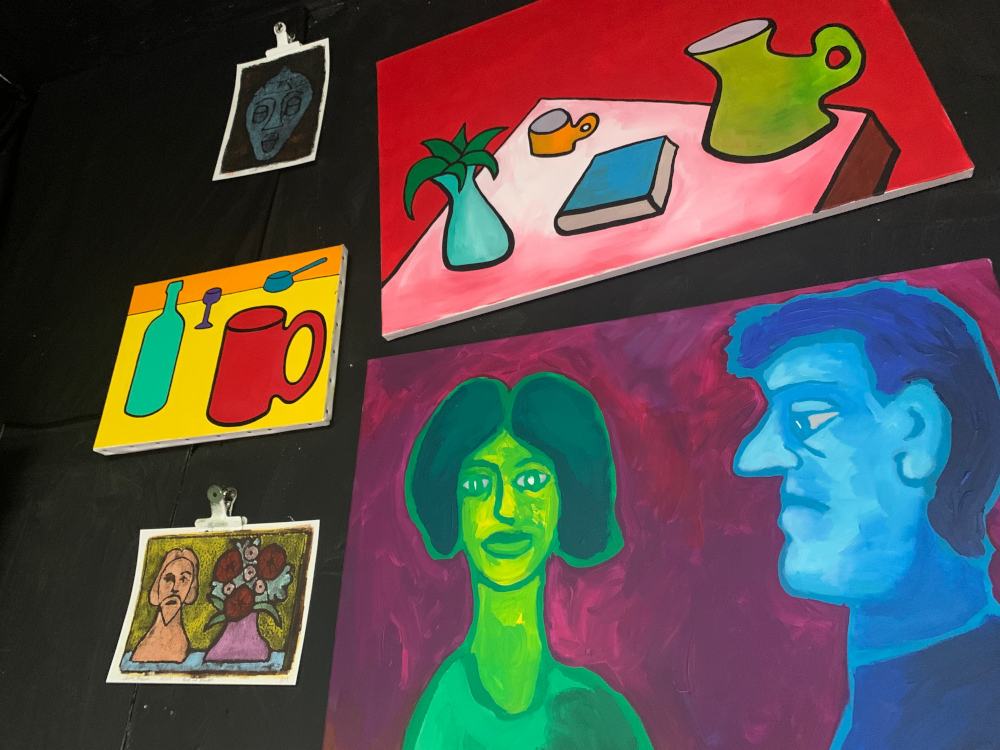
Media Reaction to The Founding, Manifesto and Rules of The Other Muswell Hill Stuckists

Site managed by Black Ivory
Site Map | Instagram | Fan Club

Published in The Other Muswell Hill Stuckist newspaper, December 2012.

MEDIA REACTION TO THE FOUNDING MANIFESTO AND RULES OF THE OTHER MUSWELL HILL STUCKISTS

The New Statesman: “…a pinch of history and a sense of humour – The Founding, Manifesto and Rules of the Other Muswell Hill Stuckists was issued on 20 February 2009. Blast novelty. Bless authenticity. Long live the cup of tea!” – 27 January 2011.

Carluke Gazette:”…the wearisome Stuckists… I could understand having one of their pronouncements (the Founding, Manifesto And Rules Of The Other Muswell Hill Stuckists is the wittiest, denouncing “YBA” as “You’ll Believe Anything” and features the most succinct definition of their position; “to be unconventional is to conform”…but all three?” – 12 January 2011. –

Peter Murray, in The Irish Examiner: “…peevish utterances of suburban intellectuals. A recent example, issued in 2009 by “the Other Muswell Hill Stuckists”, illustrates the redundancy of the form. Published on the centenary of Marinetti’s manisfesto, the activists of Muswell Hill manage little more than a tired denounciation of the Groucho Club, the Turner Prize and Tracey Emin. At least their manifesto is short. Less witty, and much too long, is the 2008 Manifesto Towards a New Humanism in Architecture…” – 26 February 2011.
(The Other Muswell Hill Stuckists maintain that they never denounced The Groucho Club.)

Alex Danchev in The Independent: “One hundred years to the day after the founding manifesto of Futurism was splashed across the front page of Le Figaro, The Founding Manifesto and Rules of The Other Muswell Hill Stuckists was published online. As their moniker might suggest,

The Other Muswell Hill Stuckists have a sense of humour. They believe in painting, as opposed to conceptual art. “Running is not art. Scrunching up a sheet of paper into a ball is not art. Sticking blu-tack on the wall is not art. People who think it is need to get out more.” If Damien Hirst’s dead sheep is truly the Stuckist bête noire, Tracey Emin’s unmade bed runs it a close second. The Stuckists mobilised against the Young British Artists (“YBA means you’ll believe anything”), the Turner Prize, and the Tate. As a body, or a cause, they may be irremediably marginal, not to say parochial, yet from time to time they have been surprisingly effective. Their very existence is a tonic. Wyndham Lewis was once said to be a kind of British (or English) rearguard action against the Futurist incursion – the arrière-garde against the avant-garde. The Stuckists seem to show that there is space for an English arrière-garde after all.” 11 February 2011.

The Observer – The New Review: William Skidelsky selects four, including The Founding, Manifesto and Rules of The Other Muswell Hill Stuckists. – 23 May 2011.

A MANIFESTO TO END 100 YEARS OF MANIFESTOS

On the 20th February 2009, 100 years to the day after the first, and main manifesto of The Futurists, The Other Muswell Hill Stuckists released “The Founding, Manifesto and Rules of The Other Muswell Hill Stuckists” in opposition. Professor Alex Danchev collated 100 art manifestos covering this 100 year period, opening with the Futurists and closing with The Other Muswell Hill Stuckists. These manifestos, together with his own writings comprised his book, 100 Artists Manifestos: From the Futurists to the Stuckists (published in 2011 by Penguin – Modern Classics), which also included the Stuckists first, and Remodernism manifesto. As of this writing in December 2012, Danchev’s book is in its forth printing.

Speaking of The Other Muswell Hill Stuckists on ABC Radio National, in Australia On 25 May 2011, Danchev said “The Stuckists are also in the vein of wit, in the vein of being against something.”

Join the Fan Club to receive our regular publications
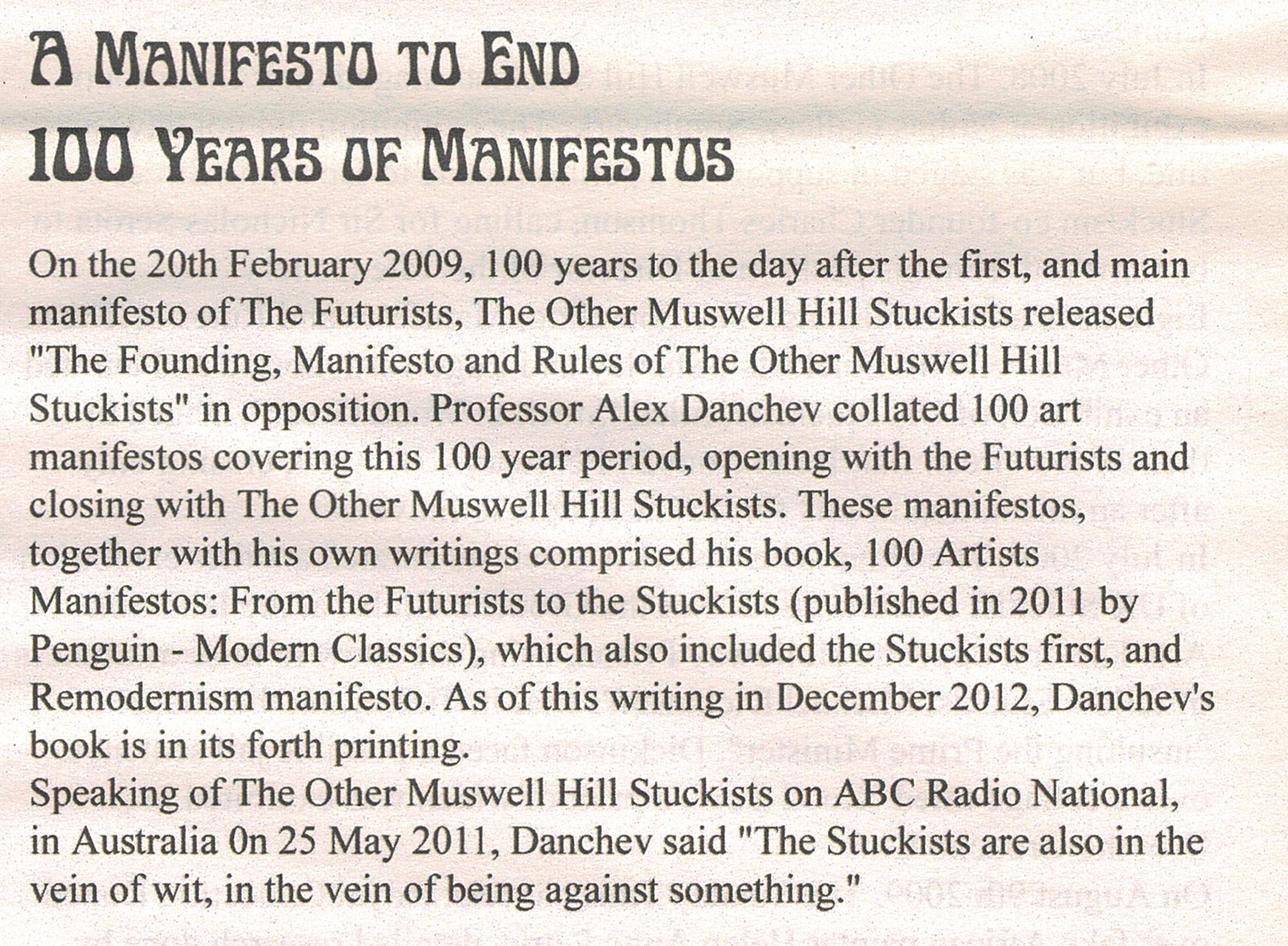
(Free worldwide shipping included).

Watch our Weekly Instagram Live Video Podcast: Thursday nights at 7pm GMT.

Site managed by Black Ivory
Site Map | Instagram | Fan Club