Tag Archives: stuckists

The Other Muswell Hill Stuckists

Site managed by Black Ivory
Site Map | Instagram | Fan Club

First published in The Other Muswell Hill Stuckist newspaper, December 2012.

The Other Muswell Hill Stuckists (aka The OMH Stuckists) were founded in 2006 by Edgeworth Johnstone, and now comprises of four artists: Edgeworth Johnstone and Shelley Li from Muswell Hill, Emma Pugmire from Crouch End, and Justin Piperger from Holloway.

Shelley Li has translated many Stuckist documents into Mandarin Chinese.

In July 2008, The Other Muswell Hill Stuckists staged their first group exhibition at Nolias Gallery, Southwark. The exhibition did not have a title, but was staged in support of a petition made to Downing Street by Stuckism co-founder Charles Thomson, calling for Sir Nicholas Serota to be removed from his position of Director of the Tate Gallery.

Eight days after publishing ‘The Founding, Manifesto and Rules of The Other Muswell Hill Stuckists’, Shelley and Edgeworth hosted and curated an exhibition of UK Stuckists, titled ‘Stuck in Wood Green’, staged in their Wood Green flat. It ran from 28 February – 30 April, closing only after an infestation of rats forced the couple to move out.

In July 2009, The Other Muswell Hill Stuckists curated another exhibition of UK Stuckist artwork titled ‘Not the Groucho Club’, at the Islington Arts Factory opposite Holloway Prison, using the show to raise awareness of fellow Stuckist Michael Dickinson’s trial in Turkey, on the charge of “insulting the Prime Minister”. Dickinson faced a possible jail sentence over a collage titled ‘Good Boy’, a print of which was exhibited in ‘Not the Groucho Club’.

On August 9th 2009, The Sunday Times article: Royal Collection Duped over fake African painter Helen Anne Petrie, detailed research done by Johnstone, after becoming suspicious of a wikipedia article claiming the artist to be in various national museums and galleries, and celebrity collections. Online records of these collections gave no mention of Helen Anne Petrie, although works by an artist of that name were recorded as being accepted into the Royal Collection.

In November 2009, Stuckism co-founder Charles Thomson spoke at the Oxford Union Debating Society discussion: This House Believes that conceptual art just isn’t Art. As part of the Stuckism display, Shelley Li and Edgeworth Johnstone from The Other Muswell Hill Stuckists attended dressed in clown outfits, as Stuckist protestors against the Tate Gallery Turner Prize.

Later that month, The Other Muswell Hill Stuckists spoke out in the Ham & High newspaper in support of Damien Hirsts paintings, which had been widely trashed in the artworld press, following an exhibition at The Wallace Collection, and the just-opened exhibitions at the White Cube galleries. Shelley Li has since founded the ‘Supporters of Damien Hirsts Paintings’ group on Facebook.

In October 2012, Edgeworth Johnstone published on his blog support for Damien Hirst’s claim to have not plagiarised a similar painting by Max McLaughlin, stating that one of his own paintings it is near impossible Damien Hirst could have plagiarised has more similarities than McLaughlin’s.

In December 2009, The Other Muswell Hill Stuckists curated another Stuckism exhibition, at Matisonn Burgin Gallery, Shoreditch, East London, titled The Stuckists Christmas Sale, designing the exhibition’s poster.

In May 2010, a Stuckist was exhibited in the Tate Gallery for the first time when four of Edgeworth Johnstone’s drawings were exhibited in the Tate Modern’s Turbine Hall. The display was curated by The Museum of Everything, showing work by many UK Outsider Artists. Hugh Muir in The Guardian asked if this, and other recent examples of Stuckist work being accepted in to the art establishment signaled ‘a wind of change blowing through the art world.’

Later in 2010, Victoria Press published “Stuck Near Tate Modern”, a book of writings and artworks by Shelley Li and Edgeworth Johnstone. A copy has since been accepted into the Tate Gallery Library and Archive.

On 30th June 2010, The Other Muswell Hill Stuckists released their second manifesto, titled ‘Stuck Near Tate Modern’. It opens with the groups response to Tate Director Sir Nicholas Serota’s plans of “a radical unseating of painting and sculpture from the positions as the ‘king and queen’ of art”, by announcing their plans of “a radical unseating of Sir Nicholas Serota from his position as the king of crap”. The manifesto goes on to list a number of artists the group claims have been snubbed by the Tate Gallery as a result of Sir Nicholas Serota’s apparent anti-painting agenda, and sarcastically claims to be “looking forward to Tate Britain’s comprehensive overview of British art as promised by Dr. Stephen Deuchar in 2000.” Later points in the manifesto calling for Tate Gallery to cut its ties with BP, and a humerous acronym for T.U.R.N.E.R. P.R.I.Z.E were used on Stuckist placards at later Turner Prize demonstrations.

The Stuck Near Tate Modern Manifesto is also critical of a Martin Creed work displayed on the front entrance of Tate Britain, denouncing it as ‘an East 17 lyric’, suggesting another from the boy-band would have been more appropriate: Instead of ‘Everything is going to be alright’, The Other Muswell Hill Stuckists suggest ‘Don’t understand what’s going on’.

On 14th October 2010, members of The Other Muswell Hill Stuckists attended a Stuckist demonstration with Charles Thomson (Stuckism co-founder) and Jasmine Maddock (of The Merseyside Stuckists), outside Christie’s Auction House claiming Damien Hirst plagiarised other artists, as Hirsts work was sold to bidders inside. It was a tense demonstration, with Christie’s security staff verbally intimidating and physically shoving one demonstrator, despite the protest being carried out legally on the pavement outside.

In November 2010, Shelley Li and Edgeworth Johnstone spent two months in China, visiting the major art districts of Beijing and Shanghai, and touring villages of artists studios with Soemo Gallery owner, Lucy Tan. They came across the work of ‘East Change’, a group echoing the views of the Stuckists but internationally remain virtually unknown. The Other Muswell Hill Stuckists promoted the work of ‘East Change’ on their website with a photograph of a street sculpture by the group carrying the quote: ‘It’s been almost a century since Duchamp dubbed a urinal art. Now it’s time to break it…”

Join the Fan Club to receive our regular publications
(Free worldwide shipping included).

Watch our Weekly Instagram Live Video Podcast: Thursday nights at 7pm GMT.

Site managed by Black Ivory
Site Map | Instagram | Fan Club
Tate is Mad

Site managed by Black Ivory
Site Map | Instagram | Fan Club

9th November 2013: Charles Thomson (Stuckism co-founder) interviewed by Edgeworth Johnstone (of The Other Muswell Hill Stuckists) about Thomson’s first show at Tate Modern.

Charles Thomson: This is my piece of text art in the Bloomberg Connects. My first exhibition at Tate Modern. It’s an appropriation from something in The Other Muswell Hill Stuckist Newspaper, written by Edgeworth Johnstone, where he says “Tate is mad”. The basis of this statement was that Tate turned down a donation of 160 artworks from an international art movement, the Stuckists, which were exhibited at The Walker Art Gallery, a national museum of art in 2004. The whole show, the whole movement was offered free of charge to the Tate, and it was turned down as being of no worth. So I guess that’s a bit of a smack in the face for the Walker Art Gallery. “Fuck Off Walker” says the Tate.

On the other hand, one of the pieces turned down, of no worth, is now actually in the Tate archive, because they said that the Stuckist protests were of worth, and of interest. So there’s a postcard of my painting of Sir Nicholas Serota makes an aquisitions decision in the Tate achives, as of worth. Whereas the original painting has been turned down, as not of worth. So there you go. Something not of worth, can be made of worth, by being turned in to a postcard.

CT: It says Tate is mad.

Tate Staff Member 1: Some people.

CT: Some people. Yeah, some people.

TSM 2: It’s good they have their opinions isn’t it.

CT: Stuckism is the future. Have you heard of Stuckism?

TSM 2: Yes. They’ve been trying to be displayed many times. 

CT: They’ve been trying to be in this place?

TSM 2: Yes. They been trying to have a display many times. They’ve been proposing their works to Tate many times.

CT: Many? What they’ve been sending in their work many times? and what happens?

TSM 2: They usually get rejected I guess by the aquisitions committee.

CT: Right. Is that fair?

TSM 2: I’m not sure. I’m not the one making the decision.

CT: Who makes the decision?

TSM 2: It’s called aquisitions committee, which is probably Directors Board and some curators.

CT: Are artists on there?

TSM 2: There maybe some who are part of a Board of Trustees. There are some artists there as well.

CT: Stuckists criticise some artists. I think they actually criticise artists that are on the Board of Trustees. And then these people judge whether their work should be in the Tate. So they’re not going to want their work in, because Stucksim criticises them. So if you want your work in, you really need to be…suck up to these people and be nice. It’s politics. Politics. Here we go…Politics.

Join the Fan Club to receive our regular publications
(Free worldwide shipping included).

Watch our Weekly Instagram Live Video Podcast: Thursday nights at 7pm GMT.

Site managed by Black Ivory
Site Map | Instagram | Fan Club

Remodernism & Stuckism

Site managed by Black Ivory
Site Map | Instagram | Fan Club

First published in The Other Muswell Hill Stuckist newspaper, December 2012.

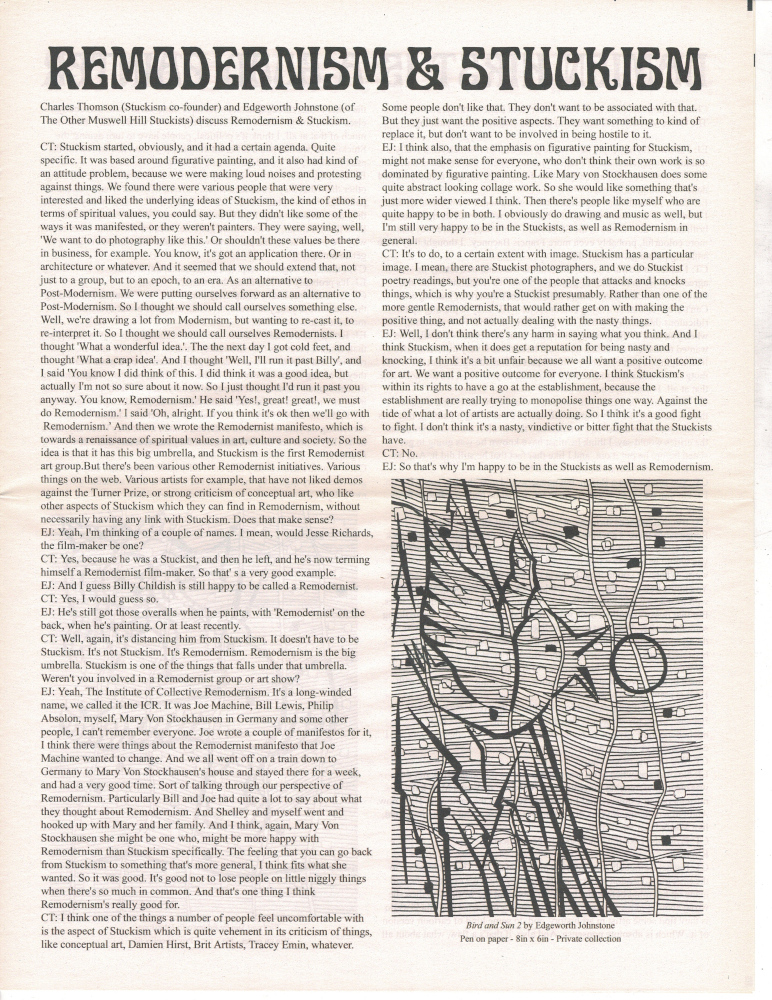
Charles Thomson (Stuckism co-founder) and Edgeworth Johnstone (of The Other Muswell Hill Stuckists) discuss Remodernism & Stuckism.

CT: Stuckism started, obviously, and it had a certain agenda. Quite specific. It was based around figurative painting, and it also had kind of an attitude problem, because we were making loud noises and protesting against things. We found there were various people that were very interested and liked the underlying ideas of Stuckism, the kind of ethos in terms of spiritual values, you could say. But they didn’t like some of the ways it was manifested, or they weren’t painters. They were saying, well, ‘We want to do photography like this.’ Or shouldn’t these values be there in business, for example. You know, it’s got an application there. Or in architecture or whatever. And it seemed that we should extend that, not just to a group, but to an epoch, to an era. As an alternative to Post-Modernism. We were putting ourselves forward as an alternative to Post-Modernism. So I thought we should call ourselves something else. Well, we’re drawing a lot from Modernism, but wanting to re-cast it, to re-interpret it. So I thought we should call ourselves Remodernists. I thought ‘What a wonderful idea.’. The the next day I got cold feet, and thought ‘What a crap idea’. And I thought ‘Well, I’ll run it past Billy’, and I said ‘You know I did think of this. I did think it was a good idea, but actually I’m not so sure about it now. So I just thought I’d run it past you anyway. You know, Remodernism.’ He said ‘Yes!, great! great!, we must do Remodernism.’ I said ‘Oh, alright. If you think it’s ok then we’ll go with Remodernism. And then we wrote the Remodernist manifesto, which is towards a renaissance of spiritual values in art, culture and society. So the idea is that it has this big umbrella, and Stuckism is the first Remodernist art group.But there’s been various other Remodernist initiatives. Various things on the web. Various artists for example, that have not liked demos against the Turner Prize, or strong criticism of conceptual art, who like other aspects of Stuckism which they can find in Remodernism, without necessarily having any link with Stuckism. Does that make sense?

EJ: Yeah, I’m thinking of a couple of names. I mean, would Jesse Richards, the film-maker be one?

CT: Yes, because he was a Stuckist, and then he left, and he’s now terming himself a Remodernist film-maker. So that’ s a very good example.

EJ: And I guess Billy Childish is still happy to be called a Remodernist.

CT: Yes, I would guess so.

EJ: He’s still got those overalls when he paints, with ‘Remodernist’ on the back, when he’s painting. Or at least recently.

CT: Well, again, it’s distancing him from Stuckism. It doesn’t have to be Stuckism. It’s not Stuckism. It’s Remodernism. Remodernism is the big umbrella. Stuckism is one of the things that falls under that umbrella. Weren’t you involved in a Remodernist group or art show?

EJ: Yeah, The Institute of Collective Remodernism. It’s a long-winded name, we called it the ICR. It was Joe Machine, Bill Lewis, Philip Absolon, myself, Mary Von Stockhausen in Germany and some other people, I can’t remember everyone. Joe wrote a couple of manifestos for it, I think there were things about the Remodernist manifesto that Joe Machine wanted to change. And we all went off on a train down to Germany to Mary Von Stockhausen’s house and stayed there for a week, and had a very good time. Sort of talking through our perspective of Remodernism. Particularly Bill and Joe had quite a lot to say about what they thought about Remodernism. And Shelley and myself went and hooked up with Mary and her family. And I think, again, Mary Von Stockhausen she might be one who, might be more happy with Remodernism than Stuckism specifically. The feeling that you can go back from Stuckism to something that’s more general, I think fits what she wanted. So it was good. It’s good not to lose people on little niggly things when there’s so much in common. And that’s one thing I think Remodernism’s really good for.

CT: I think one of the things a number of people feel uncomfortable with is the aspect of Stuckism which is quite vehement in its criticism of things, like conceptual art, Damien Hirst, Brit Artists, Tracey Emin, whatever. Some people don’t like that. They don’t want to be associated with that. But they just want the positive aspects. They want something to kind of replace it, but don’t want to be involved in being hostile to it.

EJ: I think also, that the emphasis on figurative painting for Stuckism, might not make sense for everyone, who don’t think their own work is so dominated by figurative painting. Like Mary von Stockhausen does some quite abstract looking collage work. So she would like something that’s just more wider viewed I think. Then there’s people like myself who are quite happy to be in both. I obviously do drawing and music as well, but I’m still very happy to be in the Stuckists, as well as Remodernism in general.

CT: It’s to do, to a certain extent with image. Stuckism has a particular image. I mean, there are Stuckist photographers, and we do Stuckist poetry readings, but you’re one of the people that attacks and knocks things, which is why you’re a Stuckist presumably. Rather than one of the more gentle Remodernists, that would rather get on with making the positive thing, and not actually dealing with the nasty things.

EJ: Well, I don’t think there’s any harm in saying what you think. And I think Stuckism, when it does get a reputation for being nasty and knocking, I think it’s a bit unfair because we all want a positive outcome for art. We want a positive outcome for everyone. I think Stuckism’s within its rights to have a go at the establishment, because the establishment are really trying to monopolise things one way. Against the tide of what a lot of artists are actually doing. So I think it’s a good fight to fight. I don’t think it’s a nasty,vindictive or bitter fight that the Stuckists have.

CT: No.

EJ: So that’s why I’m happy to be in the Stuckists as well as Remodernism.

Join the Fan Club to receive our regular publications
(Free worldwide shipping included).

Watch our Weekly Instagram Live Video Podcast: Thursday nights at 7pm GMT.

Site managed by Black Ivory
Site Map | Instagram | Fan Club
Billy Childish & Art Hate

Site managed by Black Ivory
Site Map | Instagram | Fan Club

First published in The Other Muswell Hill Stuckist newspaper, December 2012.

Charles Thomson (Stuckism co-founder) and Edgeworth Johnstone (of The Other Muswell Hill Stuckists) discuss Billy Childish and Art Hate.

CT: The curious thing about Billy Childish, because some people say ‘Why did he leave?’ and I say ‘You’re asking the wrong question.’ The real question is ‘Why did he join?’. Because he’s so much like a solo player. How come he ended up in this group situation. Or if he is in a group, it’s like a group he started, which he essentially guides. So how come he was in this situation? And I think it happened at a particular time in his life, when there was an opening for something. Partly, I think because he was in between relationships, and there was kind of a gap, and I think he valued the interaction. Almost like a partnership one might say. And I think it was meant to happen. He was very influential and important in launching Stuckism with me. We worked together on it, and I learnt from him, and he’s learnt from me. Particularly with writing the manifesto, we came from completely different directions. His was like flamboyant, wild and rhetorical, and mine was kind of analytical, precise and logical. And by putting the two together, we came up with something that we wouldn’t have been able to do individually. And I’ve learnt those things from him, and I think he’s learnt some of those things from me as well. But the strain began to tell, on the different approaches. And I am someone that works with a group, Billy is someone that works solo. Because it’s his best approach. There’s a lot of stuff he doesn’t like, and I’m more broad-minded in terms of seeing what other people are doing. Whereas I think he ploughs his own furrow very strongly and very determinedly. It’s very difficult for him to see beyond that sometimes.

EJ: I think I heard that his first, kind of, ‘I want to leave.’ was after he saw the first show. Is that right?

CT: Yeah, probably.

EJ: I suppose having wrote the manifesto, he might have had an idea of what the work was going to be. And then he sees all these kind of different, totally different stylistically, and maybe in his eyes, quality-wise as well, different works.and probably thought, ‘No, this isn’t for me anymore.’ …But he stuck with it.

CT: Yeah, for a couple of years, till the middle of 2001. And he left at the end of a show we had called ‘Vote Stuckist’. I’ve got that on video, I interviewed him at the time, and said ‘Why are you leaving?’ But I think it was a good thing.

EJ: You think it’s good that he left?

CT: Yeah, because the tensions would have increased. He would have become increasingly dissatisfied and frustrated because work was being shown and promoted that he didn’t agree with. Also, probably the way I was doing things in the media. Some of those he didn’t like at all.

EJ: What, the Turner Prize clowns and stuff?

CT: I’m not exactly sure, as he said he was going to turn up that, and the only reason he didn’t was because he got gastroenteritis. And actually, he and I did a private kind of demo before the first official Stuckist demo, because we were invited to a Channel 4, well he was, invited to a Channel 4 launch party of some kind. Which he and I ended up getting ejected from. Because we were giving people leaflets. Mind you, they were asking for leaflets, but apparently you’re not allowed to give people something they ask for, if it’s critical. But there are other things. It’s difficult to put your finger on it. Oh, he thinks I’m vulgar in my approach to things apparently.

EJ: What, publicity-wise?

CT: Yeah, which is not entirely untrue.

EJ: Well, I wouldn’t call it vulgar. I would say effective.

CT: Yeah, well sometimes they’re the same thing. I think basically, it’s a question of control. It’s a question of style. It’s not really a question of content. Not really a question of essence. Because he’s quite happy to do things in the media. You know, wear silly hats and silly clothes. It’s just that he wants his silly hats, not my silly hats as it were.

EJ: But he’s always defended the manifesto. He always seems to say the manifesto at least, he’s very happy with. And Remodernism as well…

CT: Absolutely, he believes in what’s in the manifesto. In the Stuckist manifesto. He just thinks that most Stuckist artists aren’t a manifestation of what’s in the manifesto, where I think they are. So I think he probably feels that he is the only true Stuckist, and all the rest aren’t.

EJ: Well, what about yourself?

CT: Well, I’m probably not either. I don’t know. Apart from writing the manifesto, so he would agree with me on the ideas, but not on how they are manifested.

EJ: But he’s doing Art Hate now, which seems to have quite a few parallels with Stuckism, from what I can see.

CT: Yeah.

EJ: Do you reckon that’s him, sort of saying ‘Well, I wasn’t happy with Stuckism. This is me.’

CT: Yeah, I think it’s a real step backwards from Stuckism. Because Stuckism was proposing values, and Art Hate is such a kind of convoluted in-joke. You know, what does it mean? It just seems to be totally built on irony.

EJ: It seems visually to be quite Dada influenced to me.

CT: Yeah.

EJ: Would that explain the kind of difficulty pinning down what it is? The kind of nonsense side of it, because you had that with Dada as well.

CT: To a certain extent. I mean, I think it’s a game. It’s a bit like a schoolyard game. I don’t feel very comfortable with it. As I say, I think it’s a step back. It’s almost like a defense mechanism because no-one can fault you, because there’s nothing there to fault. It’s not got anything that it’s putting up, which it believes in. It’s quite the opposite, unless you actually going to believe in Art Hate. Or unless you say it’ s all ironic, in which case, why not say what you mean? So as far as I can see, as soon as you start questioning it, it starts to contradict itself or not have substance. It’s just clever.

EJ: Yeah.

CT: But didn’t you take part in Art Hate? Do you hate art?

EJ: I like the posters.

CT: Well as I say, they’re clever. They’re funny. They’re good graphics.

EJ: And I like filling my time with stuff that’s fun. I was out distributing Art Hate leaflets and Billy Childish books. Really just to …I like promoting Billy Childish because I think he’s a very good artist. So that’s always good. I enjoy doing it, and I just get a sense of excitement being part of it. Well, not part of it. I’m not part of it obviously. But I get a sense of excitement being near things that are happening, that Billy Childish and L-13 are doing. I visit the gallery, and I like Billy’s work, but I wouldn’t say I’m not particularly close to Art Hate, like I am with Stuckism for example.But it’s just a different thing for me.

CT: It’s quite interesting, how for most Stuckist artists, it’s kind of made no impression. Because they tend to pick up on things, and talk about them, and point them out if there are things that they think are worthwhile.

EJ: Well, we’ve already got Stuckism. That’s the thing, I mean we’re already taken care of, in any respect that I think…Maybe without Stuckism people would be more interested in, maybe stuff like that. But I think Stuckism hits the nail on the head for a lot people, and we’re very comfortable in this group, and with this kind of representation of our artwork, and as ourselves as artists. I think there’s a lot of people thinking, well that’s me. I don’t need anything. It’s like getting married. You can stop looking once you’re married.

Join the Fan Club to receive our regular publications
(Free worldwide shipping included).

Watch our Weekly Instagram Live Video Podcast: Thursday nights at 7pm GMT.

Site managed by Black Ivory
Site Map | Instagram | Fan Club

Damien Hirst is a Good Painter

Site managed by Black Ivory
Site Map | Instagram | Fan Club

First published in The Other Muswell Hill Stuckist newspaper, December 2012.

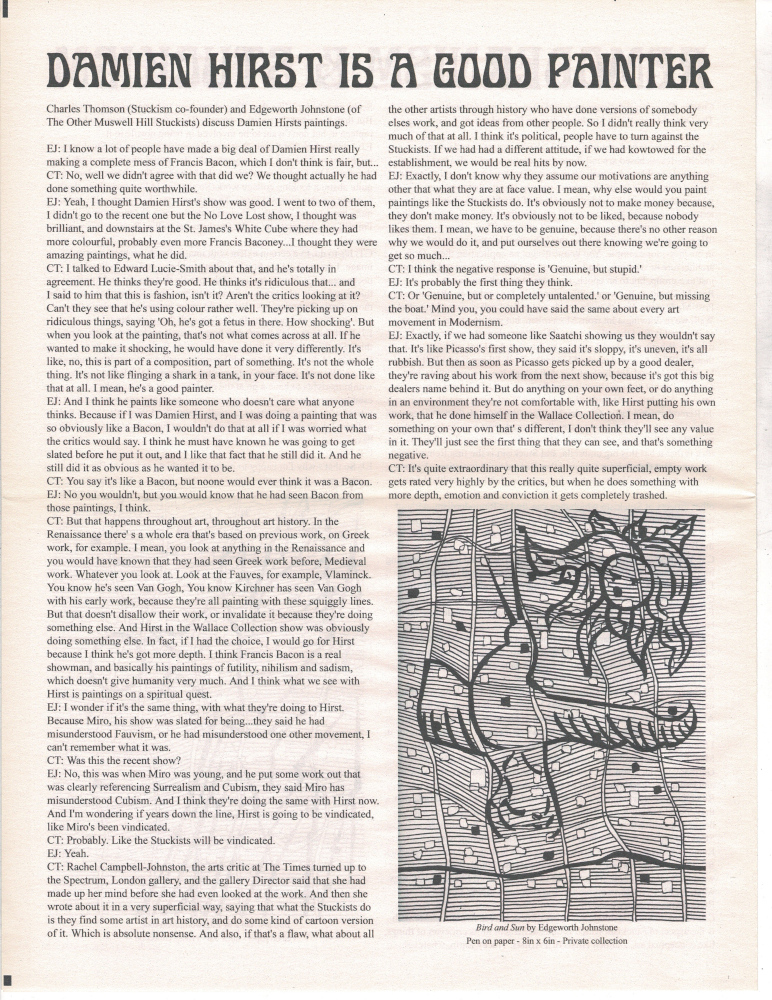
Charles Thomson (Stuckism co-founder) and Edgeworth Johnstone (of The Other Muswell Hill Stuckists) discuss Damien Hirsts paintings.

EJ: I know a lot of people have made a big deal of Damien Hirst really making a complete mess of Francis Bacon, which I don’t think is fair, but…

CT: No, well we didn’t agree with that did we? We thought actually he had done something quite worthwhile.

EJ: Yeah, I thought Damien Hirst’s show was good. I went to two of them, I didn’t go to the recent one but the No Love Lost show, I thought was brilliant, and downstairs at the St. James’s White Cube where they had more colourful, probably even more Francis Baconey…I thought they were amazing paintings, what he did.

CT: I talked to Edward Lucie-Smith about that, and he’s totally in agreement. He thinks they’re good. He thinks it’s ridiculous that… and I said to him that this is fashion, isn’t it? Aren’t the critics looking at it? Can’t they see that he’s using colour rather well. They’re picking up on ridiculous things, saying ‘Oh, he’s got a fetus in there. How shocking’. But when you look at the painting, that’s not what comes across at all. If he wanted to make it shocking, he would have done it very differently. It’s like, no, this is part of a composition, part of something. It’s not the whole thing. It’s not like flinging a shark in a tank, in your face. It’s not done like that at all. I mean, he’s a good painter.

EJ: And I think he paints like someone who doesn’t care what anyone thinks. Because if I was Damien Hirst, and I was doing a painting that was so obviously like a Bacon, I wouldn’t do that at all if I was worried what the critics would say. I think he must have known he was going to get slated before he put it out, and I like that fact that he still did it. And he still did it as obvious as he wanted it to be.

CT: You say it’s like a Bacon, but noone would ever think it was a Bacon.

EJ: No you wouldn’t, but you would know that he had seen Bacon from those paintings, I think.

CT: But that happens throughout art, throughout art history. In the Renaissance there’ s a whole era that’s based on previous work, on Greek work, for example. I mean, you look at anything in the Renaissance and you would have known that they had seen Greek work before, Medieval work. Whatever you look at. Look at the Fauves, for example, Vlaminck. You know he’s seen Van Gogh, You know Kirchner has seen Van Gogh with his early work, because they’re all painting with these squiggly lines. But that doesn’t disallow their work, or invalidate it because they’re doing something else. And Hirst in the Wallace Collection show was obviously doing something else. In fact, if I had the choice, I would go for Hirst because I think he’s got more depth. I think Francis Bacon is a real showman, and basically his paintings of futility, nihilism and sadism, which doesn’t give humanity very much. And I think what we see with Hirst is paintings on a spiritual quest.

EJ: I wonder if it’s the same thing, with what they’re doing to Hirst. Because Miro, his show was slated for being…they said he had misunderstood Fauvism, or he had misunderstood one other movement, I can’t remember what it was.

CT: Was this the recent show?

EJ: No, this was when Miro was young, and he put some work out that was clearly referencing Surrealism and Cubism, they said Miro has misunderstood Cubism. And I think they’re doing the same with Hirst now. And I’m wondering if years down the line, Hirst is going to be vindicated, like Miro’s been vindicated.

CT: Probably. Like the Stuckists will be vindicated.

EJ: Yeah.

CT: Rachel Campbell-Johnston, the arts critic at The Times turned up to the Spectrum, London gallery, and the gallery Director said that she had made up her mind before she had even looked at the work. And then she wrote about it in a very superficial way, saying that what the Stuckists do is they find some artist in art history, and do some kind of cartoon version of it. Which is absolute nonsense. And also, if that’s a flaw, what about all the other artists through history who have done versions of somebody elses work, and got ideas from other people. So I didn’t really think very much of that at all. I think it’s political, people have to turn against the Stuckists. If we had had a different attitude, if we had kowtowed for the establishment, we would be real hits by now.

EJ: Exactly, I don’t know why they assume our motivations are anything other that what they are at face value. I mean, why else would you paint paintings like the Stuckists do. It’s obviously not to make money because, they don’t make money. It’s obviously not to be liked, because nobody likes them. I mean, we have to be genuine, because there’s no other reason why we would do it, and put ourselves out there knowing we’re going to get so much…

CT: I think the negative response is ‘Genuine, but stupid.’

EJ: It’s probably the first thing they think.

CT: Or ‘Genuine, but or completely untalented.’ or ‘Genuine, but missing the boat.’ Mind you, you could have said the same about every art movement in Modernism.

EJ: Exactly, if we had someone like Saatchi showing us they wouldn’t say that. It’s like Picasso’s first show, they said it’s sloppy, it’s uneven, it’s all rubbish. But then as soon as Picasso gets picked up by a good dealer, they’re raving about his work from the next show, because it’s got this big dealers name behind it. But do anything on your own feet, or do anything in an environment they’re not comfortable with, like Hirst putting his own work, that he done himself in the Wallace Collection. I mean, do something on your own that’ s different, I don’t think they’ll see any value in it. They’ll just see the first thing that they can see, and that’s something negative.

CT: It’s quite extraordinary that this really quite superficial, empty work gets rated very highly by the critics, but when he does something with more depth, emotion and conviction it gets completely trashed. 

Join the Fan Club to receive our regular publications
(Free worldwide shipping included).

Watch our Weekly Instagram Live Video Podcast: Thursday nights at 7pm GMT.

Site managed by Black Ivory
Site Map | Instagram | Fan Club